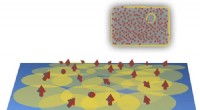
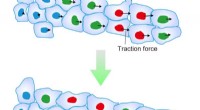
The formation of biofilms is a complex process that is influenced by a number of factors, including the availability of nutrients, the presence of other microorganisms, and the physical structure of the surface. Physicists at the University of California, Santa Barbara have now identified a new factor that controls biofilm growth: the geometry of the surface.
The researchers used a combination of experiments and computer simulations to show that the shape of the surface can determine the size and shape of biofilms. For example, they found that biofilms grown on flat surfaces were larger and more uniform than biofilms grown on curved surfaces. This is because the curvature of the surface creates a gradient of nutrients, with more nutrients available at the bottom of the biofilm than at the top. This gradient causes the biofilm to grow preferentially at the bottom, which leads to a smaller and more irregular biofilm.
The researchers' findings have implications for understanding how biofilms form and grow in a variety of environments. This information could be used to develop new strategies to control biofilm growth, which could have applications in a variety of fields, such as medicine, industry, and environmental science.
The study is published in the journal Physical Review Letters.