A new model of early-Earth cells suggests that the first life forms may have packaged their RNA in tiny, membrane-bound compartments. This model could help to explain how the first cells evolved from simple molecules.
The model was developed by researchers at the University of Illinois at Urbana-Champaign and the University of Toronto. They used a computer to simulate the behavior of a simple cell membrane made up of fatty acid molecules. The membrane was placed in a water droplet that contained RNA molecules.
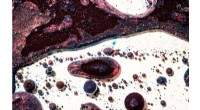
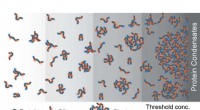
The researchers found that the membrane was able to spontaneously form small compartments that encapsulated the RNA molecules. These compartments were about the same size as the first cells.
The researchers believe that these compartments could have provided a protected environment for the RNA molecules, allowing them to survive and reproduce. This could have been a critical step in the evolution of the first cells.
"Our model suggests that the first cells may have evolved from simple, self-assembling membrane compartments," said study lead author Dr. Sidney Altman, a professor of chemistry and biophysics at the University of Illinois at Urbana-Champaign. "These compartments could have provided a protected environment for RNA molecules, allowing them to survive and reproduce."
The researchers say that their model is just a first step in understanding how the first cells evolved. However, they believe that it provides a new framework for thinking about this important question.
"We are still a long way from understanding how the first cells evolved," said study co-author Dr. Jack Szostak, a professor of genetics at the University of Toronto. "However, our model provides a new way to think about this process. We hope that it will inspire other scientists to explore new ideas and hypotheses."
The study is published in the journal Nature Communications.