By Brett Smith
Updated Mar 24, 2022

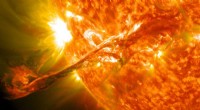
Solar flares erupt when twisted magnetic fields in the Sun’s corona snap and reconnect, unleashing vast bursts of radiation and high‑energy particles. These charged particles travel across space, reaching Earth within minutes and carrying the potential to disrupt technology and enhance natural displays.
Our modern world depends on satellites for communications, navigation, and Earth observation. A strong solar flare can generate intense electromagnetic currents that flood a satellite’s power systems and electronics. High‑energy ultraviolet radiation also heats the upper atmosphere, causing it to expand and increase aerodynamic drag on orbiting spacecraft. This can result in “zombie satellites” that lose command control or, in severe cases, deorbit and burn up in the atmosphere.
While solar energy is a clean power source, the same electromagnetic disturbances can wreak havoc on terrestrial infrastructure. Flare‑induced currents can charge the atmosphere, inducing surges along power lines that overload and destroy transformers and substations. A large‑scale outage would cripple refrigeration, sewage treatment, and other critical services, highlighting the vulnerability of our electrical grid to space weather.
Solar particles that collide with Earth’s upper atmosphere excite atmospheric molecules, producing the aurora borealis. During a powerful flare, the influx of charged particles intensifies the auroral glow, extending its reach to lower latitudes and creating brighter, more dynamic displays for observers far south of the typical viewing zones.
A 2014 study by researchers at the University of Reading found a measurable correlation between heightened solar activity and the frequency of lightning strikes. The study suggests that the charged atmosphere produced by solar flares can increase the likelihood of electrical discharge events, offering a new lens through which to predict lightning patterns.
For more detailed information, visit the NOAA Solar and Space Weather Prediction Center or the NASA Solar Dynamics Observatory.