Chad Baker/Photodisc/Getty Images
The Earth is hurtling through space at approximately 107,000 km/h (67,000 mph) as it orbits the Sun. At that velocity, any collision with space debris is inevitable, yet most of those objects are tiny.
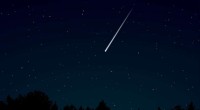
The space around us is not a void but a cloud of dust and small particles—remnants of comets and fragmented asteroids—collectively called meteoroids. When the Earth encounters one of these particles, it is often seen as a shooting star.
As a meteoroid plunges into the upper atmosphere, its relative speed—typically 40,000–260,000 km/h—causes intense friction that vaporizes the outer layer in a process known as ablation. The resulting glowing trail is what we observe as a meteor. The object’s momentum slows dramatically at the retardation point, usually several miles above the ground, where it may either burn up completely or begin to descend under gravity.
During ablation, the meteoroid’s surface can reach temperatures of several thousand degrees. By the time it reaches the retardation point, the hot exterior has largely vaporized, leaving a cooler core that can survive the passage and reach Earth as a meteorite. Roughly 10 to 50 such rocks land on Earth each day, with about two to twelve being recoverable, according to the American Meteor Society. Notable finds include the Nantan meteorite of 1516 in China and the Launton meteorite of 1830 in England.
Objects weighing more than about 10 tons (9,000 kg) retain a portion of their cosmic velocity, enabling them to strike the ground with significant kinetic energy. For example, a 10‑ton meteoroid traveling at 90,000 mph (40 km/s) could impact at roughly 5,400 mph (2.4 km/s), even after partial ablation. Atmospheric drag has negligible effect on bodies exceeding 100,000 tons (90 million kg).
While most space dust burns harmlessly in the sky, understanding these processes is essential for assessing the risks posed by larger meteoroids.