Our decades‑long exploration of the solar system has uncovered climates that are both astonishingly familiar and profoundly alien. From scorching day‑side heat on Mercury to methane‑laden storms on Neptune, each planet’s weather is a testament to its unique composition and orbital dynamics.
Mercury, the innermost planet, experiences extreme temperature swings: up to 425 °C (800 °F) during the day and plunging to –200 °C (–330 °F) at night. Its tenuous exosphere, stripped by solar wind, contains only trace amounts of oxygen and sodium, which are continuously replenished by meteoroid impacts and solar radiation.
Venus’s thick, carbon‑dioxide‑rich atmosphere traps heat, yielding surface temperatures around 462 °C (870 °F) – hot enough to melt lead. Lightning storms erupt in the upper cloud layers, but the dense lower atmosphere buffers the surface from most electrical activity. NASA’s Venus missions continue to refine our understanding of its super‑rotating winds.
Mars is a cold, arid world with an average surface temperature of –63 °C (–81 °F). Its thin atmosphere, dominated by CO₂, cannot retain heat, resulting in dramatic temperature swings. Dust storms, ranging from localized whirlwinds to planet‑wide events, dominate Martian weather. Occasionally, nightfall brings frost crystals to the surface as residual water vapor condenses on cold regolith.
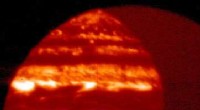
Jupiter is a gas giant composed of hydrogen and helium clouds encircling a dense, hot core that may reach ~20,000 °C (36,000 °F). The planet’s atmosphere hosts the iconic Great Red Spot—a cyclonic vortex that has persisted for over 400 years. Powerful storm systems and turbulent jet streams dominate Jupiter’s weather patterns. The Juno mission provides unprecedented insights into its atmospheric dynamics.
Saturn shares many atmospheric traits with Jupiter but features a unique hexagonal storm at its north pole, first imaged by Voyager. Equatorial winds can exceed 1,600 km/h (1,000 mph), while the planet’s helium‑rich envelope gradually condenses onto its core under immense pressure. Saturn’s atmospheric dynamics continue to intrigue researchers exploring its complex wind shear.
Uranus, an ice giant, maintains an average temperature of –193 °C (–315 °F). Its methane clouds create a striking blue hue, while ammonia ice crystals form the upper haze layers. The planet’s highly inclined axis causes prolonged seasons, triggering dramatic atmospheric changes when one pole transitions from darkness to sunlight, leading to massive storms.
Neptune’s atmosphere is dominated by hydrogen, with methane giving it a deep blue color. Wind speeds reach up to 1,931 km/h (1,200 mph), making it the fastest‑moving planet in the solar system. Occasionally, cloud holes reveal the planet’s deeper layers, indicating powerful convection and a hidden, hot interior that prevents global freezing.
Pluto and other Kuiper Belt objects experience extreme cold, with surface temperatures falling below –227 °C (–378 °F). Their thin atmospheres, primarily nitrogen with traces of methane and carbon monoxide, are in constant sublimation equilibrium with surface ices. Recent observations from the New Horizons flyby reveal subtle weather phenomena, such as transient cloud formation and seasonal haze layers.

These observations, largely sourced from NASA missions and peer‑reviewed studies, illustrate the rich diversity of planetary atmospheres and underscore the importance of continued exploration.