SCIEPRO/Science Photo Library/GettyImages
Space continues to reveal new wonders, but the fundamentals of our solar system remain well established: eight major planets orbit the Sun—Mercury, Venus, Earth, Mars, Jupiter, Saturn, Uranus, and Neptune. While all four giant planets—Jupiter, Saturn, Uranus, and Neptune—possess rings, the sheer scale and visibility of Saturn’s rings make them the most remarkable.
Saturn’s rings are estimated to number between 500 and 1,000 distinct components, far outnumbering the modest rings of its counterparts. Neptune hosts six rings, Uranus has 13, and Jupiter has only four. Mercury, Venus, and Mars lack ring systems entirely.
Jupiter, the fifth planet from the Sun, is a gas giant enveloped in swirling clouds of ammonia and water vapor. Although it has no solid surface, a likely rocky core roughly Earth‑sized may lie beneath the atmosphere. A 10‑hour rotation period gives Jupiter the shortest day in the solar system, while its orbit takes about 12 Earth years to complete.
Its faint rings—discovered by the Voyager 1 probe in 1979—are composed of minute dust particles ejected when micrometeoroids strike its small inner moons. The four rings are named the Halo, Main, Amalthea Gossamer, and Thebe Gossamer rings. The Halo ring lies nearest to the planet, spanning roughly 20,000 km in width and resembling diffuse cloud‑like structures. Adjacent to it, the Main ring stretches about 7,000 km across the orbits of the moons Adrastea and Metis. The Amalthea Gossamer ring extends outward along Amalthea’s orbit and contains dust particles about the size of cigarette‑smoke particles. The Thebe Gossamer ring, the faintest of the set, overlaps the Main ring near Thebe’s orbit.
Saturn, the sixth planet from the Sun and the second‑largest in the system, is also a gas giant primarily composed of hydrogen and helium. Its rotation period is 10.7 hours, and it completes an orbit every 29.4 Earth years. With an axial tilt of 26.73°, Saturn experiences seasons similar to Earth’s.
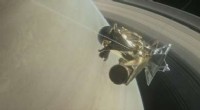
First observed through Galileo Galilei’s telescope in 1610, Saturn’s rings were later examined in detail by the Pioneer 11 and Cassini missions. Each major ring is approximately 400,000 km wide—roughly the distance from Earth to the Moon—but only about 100 meters thick. The rings consist of countless icy particles ranging from mountain‑sized chunks to sub‑millimeter grains.
While the exact age of the rings remains debated, Cassini’s 2017 observations suggested they may be around 100 million years old, considerably younger than the 4.6‑billion‑year‑old planet itself.
Both giants host extensive satellite systems. Jupiter’s 79 confirmed moons—including the four Galilean moons Io, Ganymede, Europa, and Callisto—give it a miniature “solar system.” Ganymede is the largest moon in the solar system, even exceeding Mercury in size. Io’s intense volcanism and Europa’s potential subsurface ocean make these moons subjects of ongoing research.
Saturn currently has 53 confirmed moons, with 9 additional candidates awaiting official designation. Titan, the largest of these, possesses a thick, hazy atmosphere, while Phoebe features a heavily cratered surface.
For more detailed information on Saturn’s rings, visit the NASA Solar System Exploration page: Saturn Overview.