Biletskiy_Evgeniy/iStock/GettyImages
The four inner planets—Mercury, Venus, Earth, and Mars—are collectively called terrestrial planets. They share a rocky, solid surface, a metallic core, and a relatively small size compared to the outer gas giants.
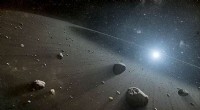
The asteroid belt provides a clear spatial boundary: all terrestrial planets lie inside it, while the gas giants and other bodies occupy the outer region.
Inner planets are compact, rocky, and contain iron cores.
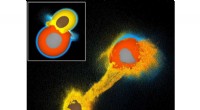
In the early solar system, a protoplanetary disk surrounded the Sun. Heavier elements like iron and nickel condensed closer to the Sun, forming the dense cores of the terrestrial planets. Lighter gases—hydrogen, methane, water vapor—condensed farther out, giving rise to the outer gas giants.
Earth dominates with a 6,378‑km (3,963‑mi) diameter, followed by Venus at 6,051 km (3,760 mi). Mars is smaller, 3,396 km (2,110 mi), and Mercury is the smallest at 2,439 km (1,516 mi). Even the largest moons—Ganymede and Titan—exceed Mercury’s size.
All terrestrial planets feature mountains, valleys, plains, and impact craters. Mercury’s bare, crater‑laden surface resembles the Moon, while Venus is cloaked in dense, cloud‑filled atmosphere. Earth boasts a mix of oceans and land, and Mars displays Olympus Mons, the tallest mountain, and Valles Marineris, one of the deepest canyons.
Thin atmospheres reveal surface details, but Venus’s clouds obscure most of its terrain.
During accretion, molten iron and nickel sank to the center, leaving lighter silicates above. Earth’s core is partially liquid, inferred from seismic wave behavior; the other terrestrial planets likely have similar partially molten interiors, generating their magnetic fields.
Core‑generated magnetism is a hallmark of terrestrial planets.
While they share fundamentals, differences abound: Earth and Mars have moons (Earth’s Moon and Mars’ Phobos, Deimos); only Earth has confirmed life. Mars carries polar ice caps of water and CO₂; Earth’s density is 5.51 g cm⁻³, Venus 5.24 g cm⁻³, Mars 3.93 g cm⁻³, Mercury 5.43 g cm⁻³.