Vega, one of the brightest stars visible from Earth, has long captivated astronomers and mythmakers alike. Its prominent position high in the sky has made it a cornerstone of ancient cosmologies and a primary target for stellar research.
In 1850, Vega became the first star outside the Sun to be photographed, a milestone followed in 1872 by the first spectroscopic determination of a stellar composition. Its stability in brightness also led to its adoption as a standard in the magnitude system.
The 1984 detection of a circumstellar debris disk around Vega marked the first time a planetary‑esque ring of dust was observed around a main‑sequence star. Since then, hundreds of such disks have been cataloged, but Vega’s remains exceptional.
The latest observations from JWST’s Mid‑Infrared Instrument (MIRI) in 2024 reveal a debris disk that is astonishingly symmetric. The ring is centered on the star with only a 0.2 % deviation from a perfect circle, and it shows almost no substructure.
This level of circularity contrasts sharply with the disk around Fomalhaut, a star of similar spectral type. Fomalhaut’s ring is noticeably eccentric (0.12–0.31) and offset from the stellar core, producing a modest asymmetry.
Perhaps most striking is the absence of prominent gaps or warps that would betray the presence of large planets. The disk appears as a single, smooth ring with only a faint, central band dividing inner and outer components, implying that any planets orbiting Vega must be either too small or too close to the star to disturb the dust.
Detecting exoplanets around Vega is challenging because the star’s rotation axis points nearly toward Earth, eliminating the usual edge‑on techniques—radial‑velocity, transit photometry, or microlensing—that rely on orbital inclination.
Given the pristine nature of Vega’s disk, astronomers expected it to betray indirect signs of planetary influence, such as eccentric offsets or sharp edges. The absence of such features does not rule out planets; it simply means any existing bodies are either low‑mass or lie within the inner, unresolved region.
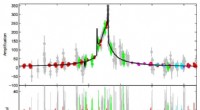
The most compelling hint of a planet emerged in 2021, when a decade‑long monitoring campaign revealed minute Doppler wobbles that could be explained by a Neptune‑mass planet orbiting within the Mercury‑analog zone. Modeling suggests a hot Neptune would fit seamlessly into the current disk architecture.