Space’s vastness hides countless mysteries that even the most advanced scientists struggle to explain. One reason is sheer scale and the limits of our instruments. For example, the light we see from the Andromeda galaxy today is about 2.5 million years old, and that is the nearest galaxy to our own.
Despite these challenges, humanity has made remarkable strides. From mapping the universe’s largest structures to discovering exotic boundaries in interstellar space, we now understand many puzzles that once seemed unsolvable. Below we highlight eleven planetary mysteries that recent research has finally unraveled.
Elva Etienne/Getty Images
NASA’s plans to send crews to Mars in the 2030s, backed by SpaceX’s ambitious colonization goals, hinge on finding water on the red planet. In 2025, scientists at the University of Bern and Brown University used machine‑learning algorithms to analyze images of the streaks on Olympus Mons first noted by Viking in the 1970s. These features had been proposed as salty water channels. The AI, trained on data from multiple missions, concluded that the streaks are driven by wind and dust dynamics, not liquid brine.
buradaki/Shutterstock
Mercury’s proximity to the Sun made it a difficult target for early astronomers, but the 2004 launch of NASA’s Messenger spacecraft changed that. From 2011 to 2015, Messenger orbited Mercury, ultimately crashing into its surface to send back a wealth of data. The mission showed Mercury cools rapidly, shrinking its diameter by about 8.5 miles, revealed a weak, oblique magnetic field, and mapped a surface made of both young impact craters and older interior material uplifted over time.
Artsiom P/Shutterstock
While the previous AI study ruled out surface brine, NASA’s InSight lander (2018‑2022) detected seismic waves indicating a massive underground ocean. Seismic data suggest a water layer up to 13 miles thick, implying that Mars once retained much more liquid water than previously thought. Though inaccessible for settlers, this reservoir may offer clues about the planet’s past habitability and the distribution of subsurface water on rocky worlds.
Buradaki/Getty Images
Uranus’s 1986 flyby by Voyager 2 revealed a confusing lack of plasma and unexpected radiation belts. In 2024, a reanalysis of that data showed the probe encountered a strong solar wind just before the encounter, temporarily distorting the planet’s magnetosphere. Dr. Linda Spilker of JPL praised the new insight, noting that it resolves long‑standing contradictions and reshapes our understanding of Uranus’s space environment.
Rawpixel.com/Shutterstock
Jupiter’s polar auroras emit intense X‑ray pulses that had defied explanation for decades. A 2021 study combining data from NASA’s Juno spacecraft and ESA’s XMM‑Newton telescope revealed that solar‑wind interactions with Jupiter’s magnetic field generate ion cyclotron waves. These waves accelerate charged ions into the planet’s atmosphere, producing the observed X‑ray bursts and providing a complete physical model of the phenomenon.
Rawpixel.com/Shutterstock
Juno’s 2019 observations uncovered Jupiter’s large cyclones that form geometric patterns at the poles. Caltech professor Andrew Ingersoll notes that these patterns echo Alfred Mayer’s 1878 experiment, where floating magnets arranged themselves into grids in water. Applying Kelvin’s mathematical model, researchers now understand that Jupiter’s storm geometry may arise from similar self‑organizing processes, although the full mechanics remain under study.
Historical/Getty Images
Io, Jupiter’s volcanic moon, has more eruptions per square kilometer than any other body in the solar system. Juno fly‑bys in 2023‑2024 clarified that Io’s 42.5‑hour orbital period forces it to stretch and compress under Jupiter’s gravity, generating tidal heat that melts interior magma pockets. Each volcano is fed by its own magma reservoir, explaining why Io can sustain such extreme volcanic activity without forming a global magma ocean.
Vladi333/Shutterstock
Recent 2024 research proposes that Venus once possessed oceans that were stripped away by runaway greenhouse heating. As atmospheric CO₂ rose, surface temperatures escalated until water vapor underwent HCO⁺ dissociative recombination, producing CO, H, and freeing hydrogen into space. This process removed the essential building block of water, leaving the planet blisteringly hot and dry.
Artur Plawgo/Getty Images
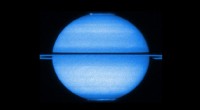
Saturn’s rare, Earth‑sized white‑spot storms erupt every few decades. Studies indicate that a lower‑altitude layer of atmospheric moisture acts as a “filter,” dampening convective motions that would otherwise form storms. Without this moisture barrier, heat would rise more freely, likely producing storms more frequently. Thus, water plays a key role in tempering Saturn’s storm cycles.
buradaki/Shutterstock
Neptune was first inferred in 1846 when Urbain Joseph Le Verrier noticed Uranus’s orbit was perturbed. Le Verrier calculated the position of an unseen planet; Johann Gottfried Galle confirmed the prediction at the Berlin Observatory. This mathematical breakthrough marked the first planet discovered through indirect observation rather than direct sighting.
Elena11/Shutterstock
While Saturn’s rings have long been a visual marvel, their origin was unclear. A 2022 study of Cassini data from MIT concluded the rings are 100‑200 million years old and formed when a moon was torn apart by Saturn’s gravity. The resulting debris now orbits the planet, also contributing to Saturn’s distinctive axial tilt relative to its neighbors.