neurobit/Shutterstock
Recent Mars rover missions have delivered the strongest evidence yet for ancient Martian life. In September, NASA announced the detection of small, leopard‑print‑like spots on the planet—patterns that are, to date, only formed by microbial life on Earth. Discovering such biosignatures on a planet 140 million miles away underscores the urgency of studying Mars’ past habitability.
The consensus among planetary scientists is that Mars once boasted a diverse hydrological system, with rivers, lakes, and streams carving its surface. The Curiosity rover’s instruments have identified ancient lake deposits, yet the majority of its imagery reveals vast stretches of dry, sedimentary rocks and a hostile landscape. These observations point to a Mars that once experienced flowing water and volcanic activity—conditions essential for sediment formation.
Iceland’s geology mirrors those ancient Martian environments almost exactly. Mike Thorpe of NASA’s Goddard Space Flight Center notes that the country’s cold rivers carve basalt canyons, exposing sedimentary layers that were originally laid down by volcanic eruptions and then reworked by water flows. The same geological sequence played out on Mars billions of years ago. The challenge now is to interpret those layers for traces of life.
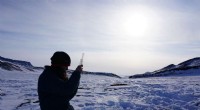
The Southwest Iceland Field Team (SWIFT) has been sampling the Stóra Laxá region in southwestern Iceland to investigate how life survives in a harsh, alien‑like setting. Their work provides a tangible laboratory for testing hypotheses about life on Mars.
By studying Earth analogues, NASA can extrapolate what to look for on other worlds. For instance, Meteor Crater in Arizona informs our understanding of lunar impact craters, while seismometers in Greenland help model the moonquakes of Jupiter’s moon Europa.
Finding life on Mars ultimately boils down to chemistry—specifically, the search for carbon, the backbone of all organic molecules. SWIFT’s investigations focus on Iceland’s hydrothermal vents, riverbeds, and lakes, collecting samples that may preserve the signatures of ancient life. Their flagship target, Lake Kleifarvatn, has a composition remarkably similar to the lakes that likely existed on Mars around 4 billion years ago. The lake’s hydrothermal vents and fine‑grained siltstone are the kinds of environments that could have fostered life on the Red Planet.
Samples from Stóra Laxá contain abundant carbon dioxide released from lake sediments, mirroring the conditions of Mars’ ancient lakes. The presence of both organic and inorganic compounds, as well as life‑supporting minerals, offers a comprehensive view of the potential for habitability. If organisms can thrive in Iceland’s extreme conditions, it strengthens the possibility that life could have survived on ancient Mars.