In astrophysics, theory often precedes observation by decades. Einstein’s Special Relativity predicted gravitational lensing, but it wasn’t until much later that telescopes could confirm it. Now, with the James Webb Space Telescope’s unprecedented sensitivity, another long‑awaited prediction is finally visible: runaway black holes.
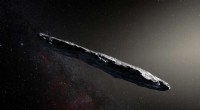
“Runaway black holes” are supermassive black holes ejected from their host galaxies, traveling at velocities that keep them on open, intergalactic trajectories. They are analogous to interstellar comets like 3I/ATLAS, which were seen plowing through our solar system from outside the Milky Way. Though the scales differ, both objects are launched at high speeds by gravitational slingshots when two massive bodies pass each other at just the right distance and angle. In this latest discovery, the supermassive black hole was likely hurled by another supermassive companion.
While we cannot see a black hole directly, its passage leaves a detectable imprint on surrounding stars. An unpublished 2025 preprint on arXiv reports a 200,000‑light‑year stellar contrail, trailing a bright “supersonic bow shock” that forms the head of the stream. Calculations suggest the black hole is fleeing its host galaxy’s center at about 2 million miles per hour.
The contrail originates from a region roughly 7 billion light years away, explaining why only the James Webb Space Telescope could resolve it. Theoretical models have entertained the possibility of runaway black holes since the 1970s, but observational proof has been elusive until now.
In 2023, Pieter van Dokkum of Yale first identified a faint streak in archival Hubble images, but the signal was too weak to distinguish individual stars. When Webb’s superior optics were directed at the same coordinates, the stellar stream resolved into a distinct bow shock and trailing wake.
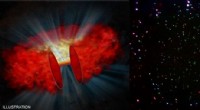
A cosmic bow shock mirrors the shape of a boat slicing through water. As the runaway black hole plows past stars at millions of miles per hour, its gravity compresses the stellar density ahead of it, forming a bright “bow.” The immense speed then disperses most of those stars into a trailing wake, leaving behind a visible trail that betrays the invisible traveler. Although the study remains a preprint, van Dokkum and colleagues are already searching for additional evidence of such high‑velocity black holes.