The Nebular Hypothesis is the prevailing scientific theory for how our solar system, including Earth, formed. It proposes that the Sun and planets emerged from a large cloud of gas and dust known as a solar nebula. Here's a breakdown of the key steps:
1. The Birth of a Solar Nebula:
* A giant molecular cloud, primarily composed of hydrogen and helium, began to collapse under its own gravity.
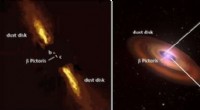
* As the cloud contracted, it spun faster due to the conservation of angular momentum. This spinning motion flattened the cloud into a disk.
* The center of the disk became incredibly dense and hot, eventually igniting nuclear fusion and forming the Sun.
2. Formation of Planetesimals:
* Within the disk, dust particles started to clump together due to electrostatic forces and collisions.
* These tiny particles grew into larger bodies called planetesimals, ranging in size from pebbles to mountains.
3. Accretion and Differentiation:
* Through continued collisions, planetesimals gradually merged, forming larger bodies called protoplanets.
* Gravity continued to pull in more material, and as these protoplanets grew, their interiors heated up.
* This internal heating led to differentiation, where heavier elements like iron and nickel sank towards the core, while lighter elements like silica rose to the surface.
4. Birth of Earth:
* Earth formed from a collection of planetesimals and protoplanets over millions of years.
* As Earth accreted material, it experienced intense bombardment from asteroids and comets, shaping its surface.
* Volcanic activity released gases, forming the early atmosphere.
* Eventually, the Earth cooled down enough for water vapor to condense, forming oceans.
Key Points to Remember:
* The Nebular Hypothesis is based on observed evidence, including the composition of planets, asteroids, and comets, as well as the observed formation of stars and planetary systems in other parts of the galaxy.
* It's a dynamic process that took billions of years to complete, shaping the Earth and our solar system as we know it today.
* While the Nebular Hypothesis provides a robust framework for understanding our planet's origin, it's still an active area of research, with scientists constantly refining our understanding of the formation process.
Further Exploration:
* Learn more about the Solar Nebula: https://solarsystem.nasa.gov/planets/index.cfm
* Explore the formation of Earth: https://www.nationalgeographic.com/science/article/earth-formation-early-earth
* Read about the Nebular Hypothesis: https://en.wikipedia.org/wiki/Nebular_hypothesis