1. Protostar Stage:
* Duration: Hundreds of thousands of years
* Characteristics: Massive clouds of gas and dust collapse under their own gravity, heating up and forming a protostar. The core is not yet hot enough for nuclear fusion.
2. Main Sequence:
* Duration: A few million years
* Characteristics: The star begins nuclear fusion in its core, primarily fusing hydrogen into helium. The immense pressure and temperature result in a brilliant blue glow.
3. Red Supergiant:
* Duration: A few hundred thousand years
* Characteristics: The star runs out of hydrogen in its core and begins fusing heavier elements like helium, carbon, and oxygen. This process causes the star to expand dramatically, becoming a red supergiant.
4. Supernova Explosion:
* Duration: A few seconds
* Characteristics: The star's core collapses catastrophically, leading to a massive explosion known as a supernova. The explosion disperses heavy elements into space, enriching the interstellar medium for future generations of stars.
5. Remnant:
* Duration: Indefinitely
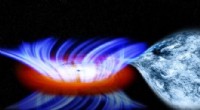
* Characteristics: Depending on the size of the star, the supernova explosion leaves behind either a neutron star (a dense, spinning object) or a black hole (a region of spacetime with infinite density).
Key Points:
* Short Lifespan: Giant blue stars live for a few million years, a blink of an eye compared to the billions of years of our Sun's life.
* Massive Size: These stars are significantly larger and more massive than our Sun.
* High Temperature and Luminosity: They are incredibly hot and luminous, radiating enormous amounts of energy.
* Violent End: Their lives end in catastrophic supernova explosions, scattering heavy elements throughout the universe.
Example: Betelgeuse, a red supergiant in the Orion constellation, is expected to explode as a supernova in the next few thousand years.