Here's why:
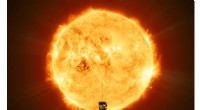
* Gravity and Velocity: The primary force governing a planet's orbit is gravity. The sun's gravity pulls on the planet, trying to pull it in. However, the planet also has a velocity, which keeps it moving forward.
* Balance: The balance between gravity and velocity is what creates the elliptical orbit.
* When a planet is closest to the sun (perihelion), it's moving faster because the sun's gravity is strongest.
* When the planet is farthest from the sun (aphelion), it's moving slower because the sun's gravity is weaker.
* Newton's Laws: Sir Isaac Newton's laws of motion and universal gravitation explain this behavior. He demonstrated that the path of an object in orbit is determined by the initial velocity of the object and the gravitational force acting on it.
Why are orbits often depicted as circles?
* Simplification: Circular orbits are easier to understand and draw than ellipses. They are a simplified representation of the actual motion.
* Nearly Circular Orbits: Many planets in our solar system have orbits that are very close to circular. The difference between a circle and an ellipse is very small in these cases.
Key takeaway: While it's convenient to think of planets moving in circles, they actually follow elliptical paths due to the balance of gravity and velocity.