1. Formation of the Solar System:
* The solar system formed from a rotating disk of gas and dust.
* As the Sun formed at the center, the remaining material coalesced into planetesimals, which eventually grew into planets.
2. The Role of Jupiter:
* Jupiter, the largest planet in the solar system, formed early on and exerted a strong gravitational influence.
* This influence disrupted the formation of a planet in the region where the asteroid belt now lies.
3. Asteroid Belt Formation:
* Instead of a single planet forming, the gravitational interactions of Jupiter caused the planetesimals in that region to collide and fragment.
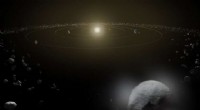
* The resulting debris, which was too small to coalesce into a planet, remained trapped in a stable orbit around the Sun.
* These pieces of rock and metal make up the asteroid belt.
4. Why It's Located Between Mars and Jupiter:
* The asteroid belt sits in a region where Jupiter's gravitational pull is strong enough to disrupt planet formation but not strong enough to completely clear the region.
* This location is also considered the "frost line" of the early solar system, where temperatures were cool enough for volatile substances like water ice to condense.
5. Other Contributing Factors:
* Resonances with Jupiter: The asteroid belt is not uniformly populated. There are gaps and concentrations of asteroids due to resonant interactions with Jupiter.
* Collisional Evolution: Over time, asteroid collisions continue to reshape the belt, producing smaller fragments and even creating new families of asteroids.
In summary:
The asteroid belt is a remnant of planetary formation, trapped between the orbits of Mars and Jupiter due to Jupiter's gravitational dominance. It is a fascinating region that provides clues about the early solar system and the processes that shaped our planet.