The formation of Jupiter is a fascinating and complex process that scientists believe unfolded over millions of years. Here's a breakdown of the prevailing theory:
1. The Birth of a Star:
* Our solar system began as a vast, swirling cloud of gas and dust, primarily hydrogen and helium.
* Gravity pulled this material together, forming a dense core that eventually ignited, becoming our Sun.
2. The Disk of Circumstellar Material:
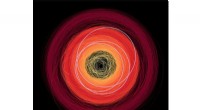
* As the Sun formed, the remaining material around it flattened into a disk. This disk contained dust grains, ice, and gas.
3. The Core Accretion Model:
* Dust grains in the disk collided and stuck together, forming larger clumps.
* These clumps attracted more material through gravity, eventually growing into planetesimals (small, rocky bodies).
* In the outer solar system, where it was cold enough, ice also played a role in planetesimal formation.
4. Jupiter's Giant Core:
* Over millions of years, a core of planetesimals, possibly a few times the mass of Earth, formed in the outer solar system.
* This core became massive enough to gravitationally attract gas directly from the disk.
5. Gas Accretion and Growth:
* Jupiter's strong gravitational pull captured massive amounts of hydrogen and helium from the surrounding disk.
* This rapid gas accretion caused Jupiter to grow rapidly, reaching its enormous size.
6. The Jovian Atmosphere:
* The captured gas formed Jupiter's thick, turbulent atmosphere, composed primarily of hydrogen and helium.
* Traces of other elements, like methane, ammonia, and water, are also present, giving Jupiter its characteristic red-brown color.
7. The Moons of Jupiter:
* As Jupiter grew, it gravitationally captured smaller bodies, which became its moons.
* These moons, like Ganymede, Callisto, Europa, and Io, also formed through the accretion process.
Key Considerations:
* Time Scale: Jupiter's formation likely spanned tens of millions of years, a significant portion of the early solar system's history.
* Disk Dynamics: The dynamics of the disk, its density, and the interactions between planetesimals played a crucial role in Jupiter's formation.
* Planetesimal Migration: While the core accretion model is widely accepted, other theories, like the disk instability model, suggest that Jupiter might have formed directly from a dense clump of gas in the disk.
Ongoing Research:
* Scientists continue to refine their understanding of planet formation through observation, computer simulations, and laboratory experiments.
* Missions like the Juno spacecraft are providing invaluable data about Jupiter's composition, structure, and magnetic field, further enhancing our knowledge of its origins.
In conclusion, Jupiter's formation is a testament to the intricate processes that govern the evolution of planetary systems. While the core accretion model provides a strong framework, ongoing research continues to unveil new insights into the complex dance of gravity and matter that resulted in this magnificent gas giant.