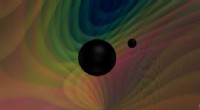
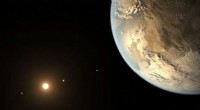
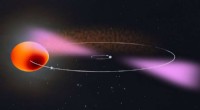
1. Gravity: The sun's immense mass creates a strong gravitational pull, attracting everything around it, including planets. This force is what keeps planets from flying off into space.
2. Inertia: Planets are constantly moving, carrying momentum from their initial formation. This momentum, known as inertia, wants to keep them moving in a straight line.
The balance:
* The sun's gravity pulls the planet towards it, trying to make it fall in.
* The planet's inertia tries to keep it moving in a straight line.
These two forces create a delicate balance, resulting in the planet following a curved path around the sun - an orbit.
Imagine a ball on a string:
* The string represents the sun's gravity, pulling the ball towards the center.
* The ball's momentum keeps it moving in a circle.
The same principle applies to planets orbiting the sun. The planets are constantly falling towards the sun, but their momentum keeps them from actually colliding.
Key points:
* Elliptical Orbits: Most planets don't have perfectly circular orbits, but rather elliptical orbits, which are slightly oval-shaped.
* Orbital Velocity: Planets travel at different speeds depending on their distance from the sun. The closer a planet is to the sun, the faster it needs to move to stay in orbit.
Understanding the interplay of gravity and inertia is key to understanding why planets orbit the sun, and it's a fundamental concept in physics and astronomy.