Comets:
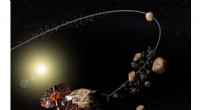
* Highly elliptical orbits: Comets have very elongated orbits, taking them far out into the solar system (sometimes beyond the orbit of Pluto) and then looping back close to the Sun.
* Highly inclined orbits: Cometary orbits are often tilted at a steep angle to the plane of the solar system (the ecliptic) compared to the orbits of most planets.
* Long orbital periods: Comets can have orbital periods ranging from a few years to millions of years, depending on their distance from the Sun.
* Often originate from the Oort cloud or Kuiper belt: Comets are thought to originate from the vast icy regions far beyond the orbit of Neptune, where they are formed and remain until perturbed into an orbit that brings them closer to the Sun.
Asteroids:
* Mostly circular orbits: Asteroids generally have more circular orbits, confined mostly to the asteroid belt between Mars and Jupiter.
* Relatively low inclinations: Asteroid orbits typically lie relatively close to the plane of the solar system.
* Shorter orbital periods: Asteroids have shorter orbital periods, usually measured in years or decades.
* Originate in the asteroid belt: Asteroids are primarily found in the asteroid belt, a region where they formed from the leftover debris from the solar system's early stages.
Key Differences:
* Shape of orbit: Comets have highly elliptical orbits, while asteroids have mostly circular orbits.
* Orbital period: Comets have much longer orbital periods than asteroids.
* Origin: Comets are formed in the outer solar system (Oort cloud or Kuiper belt), while asteroids are primarily formed in the asteroid belt.
In Summary:
The main differences in the orbits of comets and asteroids are due to their origins and formation processes. Comets are icy bodies that originate from the outer solar system, leading to their highly elliptical, inclined, and long-period orbits. Asteroids are rocky bodies formed in the asteroid belt, leading to their mostly circular, less inclined, and shorter-period orbits.