Let’s take you back to the afternoon of July 20, 1969. Two Apollo 11 astronauts in a small lunar landing vehicle have one chance to land on the Moon safely. Their landing radar has malfunctioned and the guidance computer is leading them into a field of boulders. The commander has taken manual control of the spacecraft and is trying to set the vehicle down in a safe spot with precious few seconds of fuel remaining. The consequences of running out of fuel before landing would be a disastrous crash, death of the astronauts, and failure of the mission:
HOUSTON: 30 seconds [fuel remaining].
EAGLE: Contact light! OK, engine stop . . . descent engine command override off . . .
HOUSTON: We copy you down, Eagle.
EAGLE: Houston, Tranquility Base here. The Eagle has landed!
HOUSTON: Roger, Tranquility. We copy you on the ground. You've got a bunch of guys about to turn blue. We're breathing again. Thanks a lot. “
[source: Transcript of communications between Apollo 11 and NASA Mission Control]
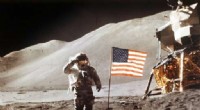
Later that night, astronaut Neil Armstrong stepped off the landing pad of the lunar module onto the surface of the Moon and said, "That's one small step for man . . . one giant leap for mankind." With these words from the Moon and the accomplishments of Apollo 11, the United States fulfilled the challenge presented by President John F. Kennedy in 1961 to be the first nation to put a man on the Moon and return him safely. The mission was a major scientific and technical achievement, a pivotal moment in human history and an event that essentially ended the long space race between the United States and the Soviet Union.
br />Photo courtesy NASAThe space race between the United States and the former Soviet Union began in the early 1950s as part of the International Geophysical Year. It escalated through the 1960’s and ended in the 1970s. What has followed is an era of cooperation between the United States, and now Russian, space programs with the building and operation of the International Space Station.
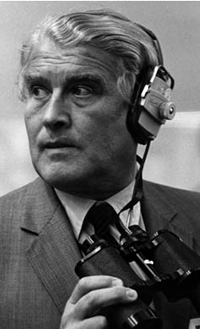
Here, we’ll look at the origins, accomplishments and tragedies of the both the United States and Russian space programs during the space race, as well as this new era of cooperation and the new space races developing in the 21st century.In the latter years of World War II, the Nazi government employed a team of rocket scientists headed by German scientist Wernher von Braun to develop, build and launch the V-2 rocket. The rockets carried explosives and were capable of striking London from their launch site on the Baltic Sea, as well as from mobile launch sites. Adolf Hitler’s dream was to have one of these rockets or rockets that are more powerful deliver a nuclear bomb to Allied countries or to the United States. However, rocket technology was not that sophisticated yet, and it was too late in the war for the realization of this dream. In the ending days of the war, von Braun led a group of scientists to surrender to the U.S. Army. With technical information and expertise, as well as captured parts from the Baltic launch sites, von Braun and his scientists began to work for the US Army in White Sands, N.M., to establish a rocket program. This program later relocated to Huntsville, Ala., where it’s now the site of NASA Marshall Spaceflight Center.
The Soviet Union also captured some German rocket scientists at the end of the war and took them to Russia where they began a rocket program. A brilliant rocket designer named Sergei Korolev headed the Soviet space program. Both von Braun and Korolev were accomplished scientists and were instrumental in the development of technologies for spaceflight. Their respective colleagues (captured Nazi scientists, American scientists, Soviet scientists) developed new rocket technologies and establish space programs in both countries.
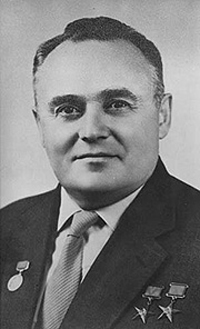
Photo courtesy NASA
Photo of Russian spacecraft designer Sergei Korolev,
1906 - 1966.
Military leaders on both sides knew the potential of using rockets to deliver warheads across great distances and wanted such advantages for their own countries. Scientists realized the potential for using rockets to deliver satellites to Earth’s orbit to study the Earth, as well as use them for the exploration of outer space.
As the rocket programs developed in both the United States and the Soviet Union, scientists from around the world joined together to designate 1957 as the International Geophysical Year, where they would band together to study the Earth. Both the United States and the Soviet Union had announced their intentions to launch satellites to study the Earth from orbit.
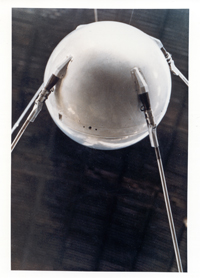
The launches of these two satellites began the space race. The interest of the American public, a strong sense of national pride, the anti-communism atmosphere of the McCarthy era, and the need for America to maintain a technological edge and superiority all combined to create the space race. Fueled by the Cold War competition and tension between the United States and the Soviet Union, Americans and their leaders felt an urgency to catch up with the Soviets in space technology and to surpass them. It was a matter of national pride.
In 1958, Congress passed the Space Act, which created NASA; the Soviet Union created a similar organization for their space program. The next logical step for both programs was to try to place a man in orbit around the Earth.
Find out who achieved that goal first in the next section.The Soviets worked on Project Vostok, their program to put a man in space and ultimately in Earth’s orbit. Meanwhile in the United States, NASA began Project Mercury and recruited seven astronauts to train and fly the Mercury spacecraft. The two programs were very different in many respects:
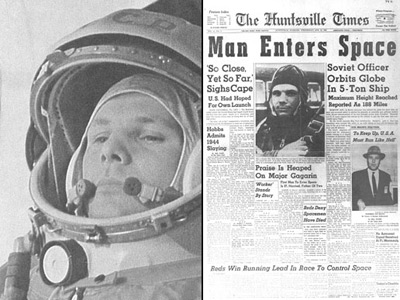
Both programs continued at feverish paces, but the Soviets became the first to place a man in space. On April 12, 1961, cosmonaut Yuri Gagarin not only became the first man in space, but also the first man to orbit the Earth in his Vostok 1 spacecraft. Again, the Soviets hailed this triumphant accomplishment, much to the embarrassment of NASA and the Americans.
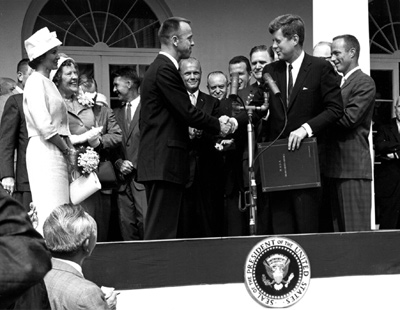
The United States responded by putting Alan Shepard into space aboard Freedom 7 on May 5, 1961. This brief, 15 minute sub-orbital flight did not match the accomplishment of the Soviets, but put America on track in the space race. Weeks after Shepard’s flight, President Kennedy challenged America and committed NASA to sending a man to the Moon and back before the end of the decade; this move clearly escalated the space race with the Soviets. With the direction of then Vice President Lyndon B. Johnson, Congress appropriated funds and NASA expanded its programs to achieve President Kennedy’s vision.
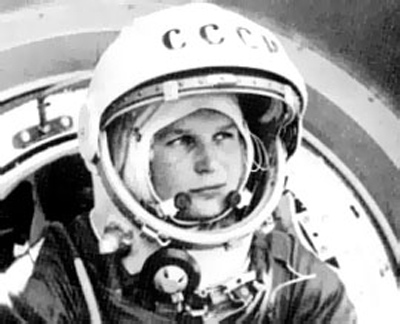
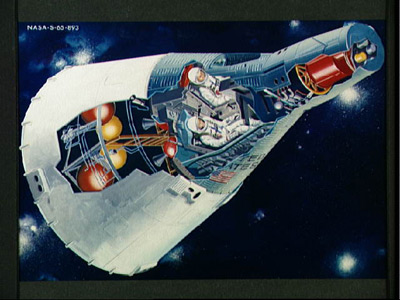
With Project Gemini, the United States quickly began to catch up and pass the Soviets in the space race. The Gemini spacecraft carried two astronauts and could maneuver in space (e.g. change orbits). Over the course of 10 missions, astronauts changed orbits, rendezvoused with other spacecraft, docked with an unmanned Agena rocket and walked in space.
Upon completion of the Gemini program, NASA learned how to fly, live, and work in space for the duration (2 weeks) necessary to send men to the Moon and back.
In contrast, the Soviets flew many unmanned Cosmos missions during this time. Most were aimed at gathering data on prolonged time in space by using animals or gathering orbital data with newly developed spacecraft, Soyuz and Zond.
With the completion of Project Gemini, America clearly had momentum to reach the Moon. Despite the setback of the Apollo 1 fire that killed astronauts Virgil Grissom, Ed White and Roger Chaffee on January 27, 1967, NASA continued to develop and build the Apollo spacecraft and Saturn V rockets to go to the Moon.
In the meantime, the Soviets had developed a powerful N1 rocket with 10 solid rocket boosters attached to it. This rocket never flew because the Soviets had trouble getting all of the boosters to work together. It was also apparent that the United States was closing in on the Moon. So the Soviets instead focused on sending unmanned spacecraft around the Moon, developing automated docking systems, and completing long-duration spaceflight in Earth’s orbit.
By the end of 1969, America completed two lunar landing missions, Apollo 11 and 12. The Soviets had sent an unmanned Zond spacecraft around the Moon. America had clearly met President Kennedy’s challenge and America had declared itself the winner of the space race because they had beaten the Russians to the Moon. While the United States continued to explore the Moon with the remaining Apollo missions, the Soviets continued developing and testing their Soyuz spacecraft and Salyut space station.
Upon completion of the Apollo moon missions in 1972, America now focused on exploring long-duration spaceflight in its Skylab space station program. Despite initial damage to Skylab upon launch, American astronauts repaired and lived in the Skylab in three missions with the final Skylab 4 flight lasting 84 days.
The space race was now over and the United States and the Soviet Union needed to decide what to do next. Their solution: join forces and conquer more of space. Read all about it in the next section.
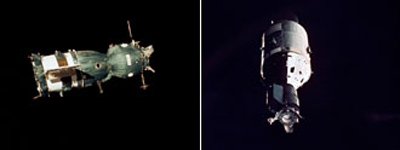
After the completion of the space race, it became clear that both space-faring nations might need to cooperate in some manner. To this effect, a joint mission with the Soviet Union was proposed, the Apollo Soyuz Test Project. An Apollo spacecraft carried a special docking module that would enable it to link up with a Soviet Soyuz spacecraft and transfer crewmembers. In 1975, an Apollo spacecraft carrying three astronauts rendezvoused and docked with a Russian Soyuz spacecraft containing two cosmonauts. The crews spent two days together conducting experiments. The flight demonstrated that the two countries could work together in space and set the groundwork for cooperation in the Shuttle/Mir program and in building the International Space Station two decades later.
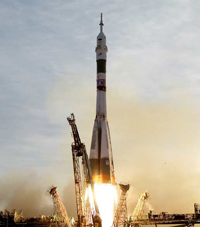
Today, the United States and Russia cooperate to build and operate the International Space Station. Part of this cooperation stems from the success of the Apollo Soyuz Test Project and from the realization that, with the Russian Mir space station, the Russians had accumulated a vast amount of experience in long-duration spaceflight (crews on Mir had endured over a year in space). With the International Space Station, crews consisting of Russian cosmonauts and American astronauts permanently inhabit the space station and switch out on a rotating basis. Crews can be launched aboard the U.S. space shuttle or the Russian Soyuz spacecraft. The space station is re-supplied by the space shuttle and by automated Soyuz and Progress supply ships. Also, a Soyuz spacecraft remains permanently docked at the station as an emergency escape vehicle.
While the Russians and the Americans work together on the International Space Station, another space race is heating up. Find out who’s in the running in this 21st century race.
Upon directives from President George W. Bush, NASA has re-examined its goals for future spaceflight. The space shuttle will be retired by 2010. A new spacecraft, the Orion Crew Exploration Vehicle is being designed to return Americans to the Moon.
Specifically, NASA is directing its efforts to the following goals:
However, NASA is not alone in this goal. Other nations besides the United States and Russia have entered space.
Besides governments, there’s a growing space race among private companies to be the first to establish sub-orbital and orbital spaceflights for space tourism. This race began with the Ansari X-prize, which was subsequently won by Scaled Composite’s SpaceShipOne (see How SpaceshipOne Works). The success of SpaceShipOne is being developed into a commercial venture called Virgin Galactic by Sir Richard Branson.
In this same spirit, the X-Prize foundation and Google have sponsored the Google Lunar X Prize, a $30 million competition for the first privately funded team to send a robot to the moon, travel 500 meters, and transmit video, images and data back to the Earth.
Such competitions and races as the original space race have brought about new technologies and products such as Mylar and GPS systems. They’ve developed new spacecraft like SpaceShipOne. And competitions between countries for national pride and between companies for profitable markets will provide incentives for the development of new space technologies and lay the foundations for the future of space exploration.
For more information on the space race, space in general and related topics, shoot over to the next page to see more links.More Great Links