1. The Giant Molecular Cloud:
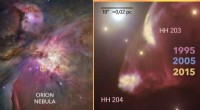
- It all began with a vast, cold, and dense cloud of gas and dust called a giant molecular cloud.
- This cloud was primarily composed of hydrogen and helium, along with trace amounts of heavier elements.
- The cloud was in constant motion, and slight gravitational instabilities could trigger its collapse.
2. Gravitational Collapse:
- Over a long period, a region within the cloud started to collapse under its own gravity.
- As it collapsed, the density and temperature increased significantly, causing the cloud to spin faster.
- This spinning cloud flattened into a disk-shaped structure, with a hot, dense core at its center.
3. Protostar Formation:
- The core of this disk eventually became so hot and dense that nuclear fusion began, igniting the protostar, which is a baby star.
- The protostar continued to grow by accreting (gathering) more material from the surrounding disk.
4. Planetary Disk Formation:
- As the protostar ignited, it released a powerful solar wind, pushing lighter elements outwards.
- Heavier elements and dust particles remained in the surrounding disk, orbiting the newly formed star.
- This disk, called the protoplanetary disk, became the birthplace of planets.
5. Planet Formation:
- Within the protoplanetary disk, dust particles began to stick together due to electrostatic forces, forming larger clumps.
- These clumps continued to grow, attracting more material through gravity.
- Eventually, these clumps grew large enough to become planetesimals, small planetary embryos.
- Planetesimals collided and merged, gradually forming the planets we know today.
6. The Inner and Outer Solar System:
- The planets closer to the Sun (inner solar system) formed from rocky materials that could withstand the Sun's intense heat.
- Planets farther from the Sun (outer solar system) formed from icy materials that could survive in the colder regions.
7. Ongoing Evolution:
- Even after the planets formed, the solar system continued to evolve.
- The orbits of the planets changed over time, and some planets experienced significant bombardments from leftover planetesimals.
- Today, our solar system is still evolving, with subtle changes in planetary orbits and the constant influence of the Sun's radiation and solar wind.
This is a simplified explanation of solar system formation, and there are still many mysteries that scientists are trying to unravel. However, the basic principles of gravitational collapse, disk formation, and accretion provide a framework for understanding how our solar system came to be.