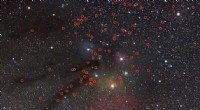
* Hydrogen and Helium: These are the most abundant elements in the universe, and they make up the vast majority of Jupiter's mass.
* Ice: Water ice, along with other ices like methane and ammonia, were also present in the disk. These ices played a crucial role in the early stages of planet formation.
* Rock and Dust: These materials provided the initial "seeds" around which larger bodies could accrete.
Here's a simplified explanation of how scientists think Jupiter formed:
1. Dust Grains Collide: Tiny dust particles in the protoplanetary disk started colliding and sticking together, forming larger clumps.
2. Gravity Takes Over: As these clumps grew, their gravitational pull became stronger, attracting more material from the disk.
3. Gas Accretion: Once the clumps became large enough, they started to accrete gas from the surrounding disk. This process was particularly efficient for Jupiter, as it formed in a region where gas was abundant.
4. Rapid Growth: Jupiter's immense gravitational pull allowed it to grow rapidly, accumulating the vast majority of its mass within a few million years.
While this is the widely accepted model, some details about Jupiter's formation are still debated, such as the exact timing and mechanism of gas accretion.
In essence, Jupiter is a giant ball of gas, primarily hydrogen and helium, that formed from the leftover material of the Sun's creation. It's a testament to the power of gravity and the vastness of the early solar system.