Here's an example:
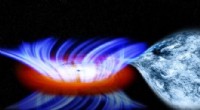
A white dwarf star.
* Hot: White dwarfs are incredibly hot, with surface temperatures reaching tens of thousands of degrees Celsius.
* Small: White dwarfs are extremely dense and much smaller than our Sun, often only slightly larger than Earth.
Because of their small size, white dwarfs don't emit a lot of light even though they are very hot. This makes them appear relatively dim compared to larger, cooler stars.
Other examples of hot but not very bright stars:
* Neutron stars: These are even smaller and denser than white dwarfs, but they are also extremely hot. They emit X-rays and gamma rays, but their visible light output is very low.
* Some main sequence stars: While main sequence stars are generally classified by their temperature, there are some smaller, hot stars that are less luminous than larger, cooler stars.
In conclusion, a star's temperature and size both play a crucial role in determining its overall brightness. While a hot star may emit a lot of light, it can still be relatively dim if it is small.