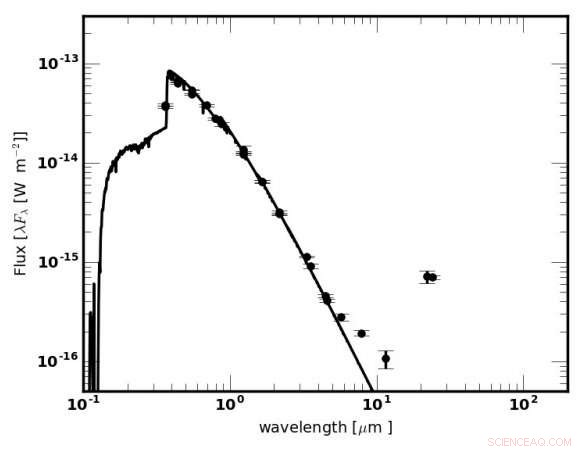
Spectral energy distribution for J005252. The black symbols represent the dereddened photometry. The black line represents the best-fitting scaled Kurucz model atmosphere. Credit: Kamath et al., 2017.
(Phys.org)—Astronomers have detected a new metal-poor, luminous post-asymptotic giant branch star in the Small Magellanic Cloud. The newly found object, designated J005252.87-722842.9, appears to have undergone an unusual evolution process. The finding was presented October 12 in a paper published on the arXiv pre-print server.
J005252.87-722842.9 (J005252 for short) was first spotted in 2014 as part of an extensive low-resolution spectroscopic survey. The object was initially identified as post-asymptotic giant branch (post-AGB) candidate with an observed luminosity of about 8,000 solar luminosities.
Post-AGB are believed to be on their way to the planetary nebula stage as they have evolved from the asymptotic giant branch as the result of a strong dusty mass loss removing most of the stellar envelope. However, the post-AGB phase is still one of the least understood phases of the evolution of low- and intermediate-mass stars. That is why astronomers are searching for new post-AGB stars that could advance knowledge of this mysterious phase of stellar evolution.
According to a new study conducted by a team of researchers led by Devika Kamath of the Catholic University of Leuven in Belgium, J005252 is a post-asymptotic giant branch star, which could be distinguished among other ordinary post-AGB stars by its unusual path of evolution. This star appears to have failed the so-called third dredge-up—a period during the process of stellar evolution when a surface convection zone extends down to the layers where material has undergone nuclear fusion. This period occurs after a star enters the AGB and a flash occurs along a helium-burning shell.
Third dredge-up enriches the stellar photosphere with products of internal nucleosynthesis such as carbon, nitrogen, oxygen and heavy elements produced by the slow neutron capture process known as the s-process. However, when it comes to J005252, the research by Kamath's team shows no signs of such enrichment.
Using the UVES echelle spectrograph at the Paranal Observatory in Chile, the researchers have conducted a detailed chemical abundance study of J005252 that provides important hints about the evolution of this star. "Through a systematic abundance study, using high-resolution optical spectra from UVES, we found that this likely post-AGB object shows an intriguing photospheric composition with no confirmed carbon enhancement nor enrichment of s-process elements," the paper reads.
The authors assume that the peculiar chemistry of J005252 could be explained by some mechanism that results in an AGB life without dredge-up episodes. They also take into account the possibility that this star could be a product of a merger scenario. However, the results of their spectroscopic observations show no signs of strong rotation that is characteristic for mergers.
Therefore, in order to finally explain this issue, the researchers plan further observations of J005252 that would reveal the abundance of other elements such as nitrogen.
"Our current spectral region does not cover usable N lines. We aim to obtain spectra covering the N lines to be able to determine if whether the N abundance can give us hints for solving the nucleosynthetic mystery of J005252," the astronomers concluded.
© 2017 Phys.org