1. The Doppler Effect:
* The Doppler effect describes the change in frequency of a wave (like light) as the source of the wave and the observer move relative to each other.
* When a source moves towards you, the waves are compressed, resulting in a higher frequency (blueshift).
* When a source moves away from you, the waves are stretched, resulting in a lower frequency (redshift).
2. Redshift of Galaxies:
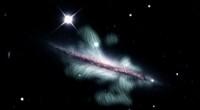
* Astronomers observe that the light from distant galaxies is shifted towards the red end of the electromagnetic spectrum.
* This redshift is interpreted as evidence that galaxies are moving away from us.
* The farther away a galaxy is, the larger its redshift, implying it is moving away from us at a faster speed.
3. Hubble's Law:
* In the 1920s, Edwin Hubble discovered a relationship between a galaxy's distance and its redshift.
* This relationship, known as Hubble's Law, states that the recessional velocity of a galaxy is directly proportional to its distance from us.
4. Expansion of the Universe:
* The observed redshift of galaxies, consistent with Hubble's Law, strongly supports the idea that the universe is expanding.
* This expansion means that all galaxies are moving away from each other, and the farther apart they are, the faster they are moving apart.
5. Big Bang Implication:
* The Big Bang theory proposes that the universe began in a very hot, dense state and has been expanding ever since.
* The observed redshift of galaxies is a direct consequence of this expansion.
* The redshift provides evidence that the universe was smaller in the past and is continuing to expand.
In summary:
The observed redshift of galaxies, consistent with Hubble's Law, provides strong evidence for the expansion of the universe. This expansion is a fundamental prediction of the Big Bang theory, making redshift a crucial piece of supporting evidence for the model.