Here's how the jet ejection works:
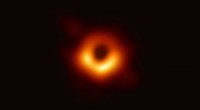
1. Accretion Disk: Material spirals inwards towards the black hole, forming a swirling accretion disk. Friction and magnetic interactions within this disk heat the material to extremely high temperatures, releasing vast amounts of energy.
2. Magnetic Field Lines: The spinning black hole generates a powerful magnetic field that extends far beyond the accretion disk. These magnetic field lines are thought to be anchored in the black hole's poles.
3. Jet Formation: As charged particles from the accretion disk interact with the magnetic field lines, they are accelerated along the field lines, forming two powerful jets. The magnetic field acts as a "launching mechanism," propelling the particles outward at relativistic speeds (close to the speed of light).
4. Opposite Directions: The magnetic field lines are aligned with the black hole's rotation axis, causing the jets to be ejected in opposite directions from the black hole's poles.
Key Factors:
* Black Hole Spin: The rotation of the black hole plays a crucial role in aligning the magnetic field lines and directing the jets.
* Magnetic Field Strength: The strength of the magnetic field determines the energy and speed of the jets.
* Accretion Disk Properties: The size, density, and temperature of the accretion disk influence the amount of material available to fuel the jets.
Observational Evidence:
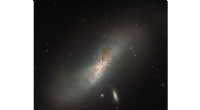
* Radio Observations: Radio telescopes have revealed the presence of powerful radio lobes emanating from the opposite ends of active galaxies, indicating the existence of jets.
* Optical and X-ray Observations: Optical and X-ray telescopes have observed the bright emission from the jets, confirming their high energy and speed.
* Polarization: The light from the jets is often polarized, indicating the presence of magnetic fields.
Further Research:
While the basic mechanism of jet ejection is understood, scientists are still trying to understand the detailed processes involved, including:
* How the magnetic field lines become anchored in the black hole's poles.
* The precise mechanism by which the magnetic field accelerates particles to relativistic speeds.
* The role of plasma instabilities and turbulence in shaping the jets.
The study of active galactic jets continues to be an active area of research, providing insights into the physics of black holes and the evolution of galaxies.