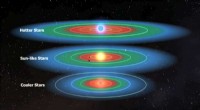
* Temperature and Color: A star's color is directly related to its surface temperature. Hotter stars emit more blue light, while cooler stars emit more red light. Think of a piece of metal heating up: it starts red, then orange, then yellow, and eventually becomes white-hot.
* Stellar Evolution: As a star ages, its core undergoes changes that affect its temperature and therefore its color. Here's a simplified explanation:
* Main Sequence: Stars spend the majority of their lives on the "main sequence," fusing hydrogen into helium in their cores. The color of a main sequence star is determined by its mass. Massive stars are hotter and bluer, while less massive stars are cooler and redder.
* Red Giant: When a star runs out of hydrogen fuel in its core, it starts to expand and cool, becoming a red giant. This expansion is due to the fusion of helium into carbon and oxygen, causing the outer layers to puff out and cool.
* Later Stages: The further evolution of a star depends on its mass. Some stars may eventually become white dwarfs, which are very hot but small and faint, appearing white or bluish. Others may become supernovae, exploding with incredible energy and leaving behind neutron stars or black holes.
In summary, a star's color changes as it ages because its temperature changes as it evolves through different stages of its life cycle.