Start: Giant Molecular Cloud
1. Nebula Formation:
- Cloud collapses under its own gravity.
- Dust and gas particles clump together.
- Rotates faster as it collapses.
2. Protostar Formation:
- Core of collapsing cloud heats up.
- Nuclear fusion ignites in the core.
- Star is born!
3. Main Sequence Star:
- Star is stable, burning hydrogen into helium.
- Length of time spent on Main Sequence depends on mass.
- Our Sun is currently in this stage.
4. Red Giant (or Red Supergiant):
- Hydrogen fuel runs out in the core.
- Star expands and cools down.
- Outer layers become cooler and redder.
5. Helium Burning:
- Core heats up further, causing helium fusion to begin.
- Star shrinks and becomes hotter.
6. Stellar Evolution (Depending on Mass):
For Low-Mass Stars (like our Sun):
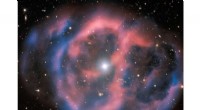
- Planetary Nebula: Star sheds its outer layers, creating a beautiful shell of gas.
- White Dwarf: Dense, hot core of the star remains, slowly cooling down over billions of years.
For High-Mass Stars:
- Supernova: Star explodes in a catastrophic event, releasing immense energy.
- Neutron Star: Core collapses into a super-dense object, composed mainly of neutrons.
- Black Hole: If the star is massive enough, the core collapses entirely, creating a region of spacetime with infinite density.
End: Death of the Star
Note: This flowchart is a simplified representation of star life. There are many variations and complexities depending on the mass and composition of the star.