Here's why:
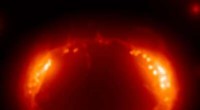
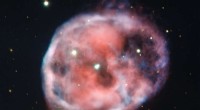
* Planetary nebulae are the remnants of dying stars. They form when a star like our Sun runs out of fuel, sheds its outer layers, and leaves behind a hot, dense core called a white dwarf.
* The process of forming a planetary nebula is destructive. The intense radiation and stellar winds from the dying star would vaporize any existing planets or prevent new ones from forming.
* The leftover material is too hot and diffuse. Planetary nebulae are mostly composed of gas and dust, but these are spread out over a vast area and are far too hot for planets to coalesce.
While the materials ejected by a dying star can be incorporated into future generations of stars and planets, the planetary nebula itself is not a suitable environment for planet formation.
Instead, planet formation typically occurs in protoplanetary disks, which are dense, rotating clouds of gas and dust that surround young stars. These disks provide the necessary ingredients and conditions for planets to form through accretion.