Here's a breakdown:
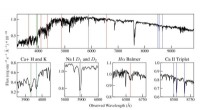
* Spectral Class: This is determined by analyzing the star's light spectrum. It classifies stars based on their surface temperature, with the hottest stars being classified as O and the coolest as M. The spectral classes are:
* O: Blue, very hot
* B: Blue-white, hot
* A: White, hot
* F: Yellow-white, warm
* G: Yellow, warm
* K: Orange, cool
* M: Red, cool
* Absolute Magnitude: This refers to the intrinsic brightness of a star, measured as if it were located at a standard distance of 10 parsecs (32.6 light-years) from Earth. The lower the absolute magnitude, the brighter the star.
Together, spectral class and absolute magnitude provide a comprehensive picture of a star's physical properties:
* Hotter stars are generally more luminous.
* The color of a star is directly related to its temperature.
There are other indicators that can be used to determine a star's properties, but spectral class and absolute magnitude are the most fundamental and widely used.