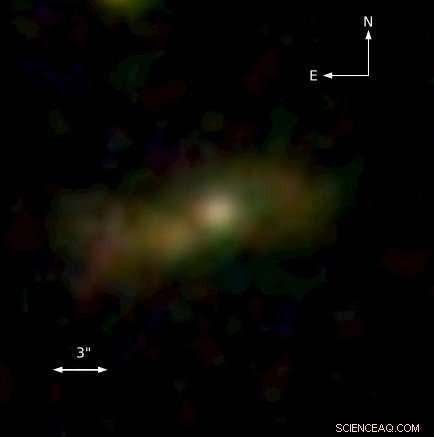
R band SDSS image of J2118-0732. Credit: Yang et al., 2018.
Researchers have identified a new blazar-like narrow-line Seyfert 1 galaxy that emits gamma-ray radiation. The new galaxy, designated SDSS J211852.96−073227.5, could offer insights into formation and evolution of jets of radiation produced by massive galactic central black holes. The findings are reported January 11 in a paper published on arXiv.org.
Narrow-line Seyfert 1 (NLS1) galaxies are a class of active galactic nuclei (AGN) that have all the properties of type 1 Seyfert galaxies, but show peculiar characteristic like narrow Balmer lines, strong Fe II emission, and extreme properties in the X-rays.
Astronomers and astrophysicists are specially interested in the radio-loud (RL) NLS1 galaxies, which usually showcase a compact radio morphology with a one-sided core-jet structure. Previous studies indicate that some RL NLS1, due to their blazar-like characteristics, produce relativistic jets—beams of ionized matter accelerated close to the speed of light.
Therefore, finding and studying new RL NLS1s could help us improve our knowledge about complex phenomena like relativistic jets as the process of their formation and evolution is still not well understood.
Now, a team of researchers led by Hui Yang of the Key Laboratory of Space Astronomy and Technology in Beijing, China, has detected new RL NLS1 galaxy emitting gamma-ray radiation. SDSS J211852.96−073227.5 (or J2118−0732 for short) was confirmed as a gamma-ray-emitting RL NLS1 galaxy by observations conducted with Large Area Telescope (LAT) onboard NASA's Fermi Gamma-ray Space Telescope and with ESA's X-ray Multi-Mirror Mission (XMM-Newton), as well as by analysis of data provided by the Sloan Digital Sky Survey (SDSS).
"Here, we present our discovery of a new γ-ray-emitting NLS1–SDSS J211852.96−073227.5 by analyzing the SDSS spectrum, the Fermi-LAT and XMM-Newton observational data," the scientists wrote in the paper.
J2118−0732 was detected at a redshift of 0.26 and has an estimated black hole's mass of about 33 million solar masses. According to the study, the galaxy's Balmer and Fe II emission lines confirm its NLS1 nature.
Furthermore, data obtained by LAT revealed the existence of gamma-ray emission from J2118−0732 at a relatively high state for about 4 years of observations. Moreover, XMM-Newton observations indicated that J2118−0732 is the brightest X-ray source in the field, exhibiting a large X-ray variability.
The researchers noted that properties of J2118−0732 such as large radio loudness, with a flat and inverted radio spectrum and remarkably rapid infrared intraday variability of less than a day, confirm its blazer-like nature.
In general, the authors of the paper concluded that the data presented in the study could shed new light on the formation and evolution of relativistic jets and jet-disk coupling.
"The broadband SED (spectral energy distribution) can be well modeled by a one-zone leptonic jet model. And the synchronous variations in the multiwavelength fluxes and the disk component suggest the coupling of the disk accretion and the jet launching," the researchers concluded.
© 2018 Phys.org