1. Mass and Evolution:
* Massive Stars: Larger, more massive stars have higher core temperatures and pressures. These conditions allow them to fuse heavier elements, producing elements like carbon, oxygen, neon, and even heavier elements like silicon and iron. This abundance of heavier elements will be reflected in their spectra.
* Evolutionary Stage: As stars age, they go through various stages of fusion. During these stages, they produce and accumulate heavier elements. Stars in their later stages, like red giants or supergiants, will have significantly more complex spectra due to the presence of a wider variety of elements.
2. Surface Temperature and Gravity:
* Surface Temperature: Stars with hotter surface temperatures can ionize heavier elements more easily, leading to distinct spectral lines. A wider range of ionization states for the elements will produce a richer, more complex spectrum.
* Surface Gravity: Stars with lower surface gravity (like giants and supergiants) have expanded atmospheres, increasing the likelihood of elements interacting with photons and producing absorption lines. This can lead to more complex and numerous spectral lines.
3. Rotation:
* Rotation Rate: Rapidly rotating stars can exhibit line broadening due to the Doppler effect. This can make spectral lines appear wider and more complex, sometimes obscuring individual lines.
4. Magnetic Fields:
* Strong Magnetic Fields: Stars with strong magnetic fields can influence the ionization and excitation states of their atoms, leading to variations in spectral line intensities and the appearance of additional lines.
5. Chemical Enrichment:
* Galactic Environment: Stars born in regions of a galaxy with higher metallicity (meaning higher abundances of elements heavier than hydrogen and helium) will inherit these elements and exhibit them in their spectra. This can lead to more complex spectra compared to stars born in metal-poor regions.
Examples:
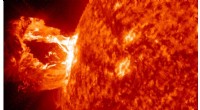
* Sun: Our Sun is relatively young and has a moderate mass. Its spectrum shows mostly hydrogen and helium with smaller amounts of heavier elements like carbon, oxygen, and iron.
* Red Giants: Red giants are older stars that have fused hydrogen into heavier elements. Their spectra are richer in heavier elements and often show spectral lines from molecules, leading to a more complex overall spectrum.
* Supergiants: These are even larger and more evolved stars. Their spectra can be extremely complex, exhibiting many lines from a wide range of elements.
In summary: The complexity of a star's spectrum depends on a combination of factors: its mass, evolutionary stage, surface temperature, surface gravity, rotation rate, magnetic field strength, and the chemical composition of the region where it was born.