Similarities:
* Both orbit the Sun: Both comets and planets are bound to the Sun by its gravitational pull, causing them to travel in elliptical paths around it.
* Governed by Kepler's Laws: Both orbits follow Kepler's laws of planetary motion, which describe the relationship between a celestial body's orbital speed and its distance from the Sun.
Differences:
1. Shape and Eccentricity:
* Planets: Generally have nearly circular orbits with low eccentricity (a measure of how oval-shaped the orbit is). This means their distance from the Sun doesn't vary drastically throughout their orbit.
* Comets: Often have highly eccentric orbits, meaning they are much more elliptical. This results in a significant variation in their distance from the Sun. They spend most of their time far away in the outer Solar System and only come close to the Sun for a relatively short period.
2. Orbital Period:
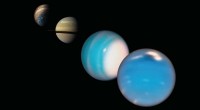
* Planets: Have relatively short orbital periods, ranging from 88 days for Mercury to 165 years for Neptune.
* Comets: Have much longer orbital periods, ranging from a few years to millions of years. This is due to their highly elliptical orbits and long journeys far out in the Solar System.
3. Composition:
* Planets: Composed primarily of rock, gas, or ice, depending on their location and formation.
* Comets: Composed mainly of ice, dust, and frozen gases. When a comet gets close to the Sun, the ice vaporizes, creating a visible tail of gas and dust.
4. Inclination:
* Planets: Orbit relatively close to the same plane as the Sun's equator, with only a small inclination (angle of their orbit relative to this plane).
* Comets: Can have much higher inclinations, meaning their orbits are tilted at a greater angle to the Sun's equator.
5. Stability:
* Planets: Have stable orbits that are unlikely to change significantly over time.
* Comets: Can have less stable orbits, especially if they encounter gravitational forces from other planets or the Sun itself. These interactions can alter their orbits significantly over time.
In summary:
Comets have highly elliptical orbits, long periods, and are composed of ice and dust, whereas planets have nearly circular orbits, shorter periods, and are primarily composed of rock, gas, or ice. These differences are due to their formation and origins in the Solar System.