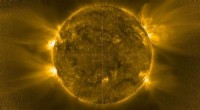
* The Fusion Barrier: Stars shine because they fuse hydrogen into helium in their cores, releasing tremendous energy. This process requires immense pressure and heat. Jupiter's core, while hot, simply doesn't have enough mass to create the necessary conditions for fusion to start.
* Minimum Mass Requirement: There's a minimum mass a celestial object needs to become a star, known as the "brown dwarf limit." This limit is about 75 times the mass of Jupiter. Objects below this limit are simply too small to sustain nuclear fusion in their cores.
* The "Star" Definition: Stars are defined by their ability to sustain nuclear fusion. While adding more mass to Jupiter would make it hotter and denser, it wouldn't necessarily make it a "star" in the traditional sense.
However, there are some interesting possibilities:
* Brown Dwarf: If you were to add enough mass to Jupiter, exceeding the brown dwarf limit but not reaching the full mass of a star, it would become a brown dwarf. These objects are often called "failed stars" because they don't fuse hydrogen, but they do undergo a different type of fusion (deuterium burning) for a short time in their lives.
* The "Giant" Jupiter: Even without becoming a star, adding mass to Jupiter would significantly impact its size and behavior. A more massive Jupiter would exert a stronger gravitational pull, potentially disrupting the orbits of the other planets in our solar system.
In conclusion: While adding mass to Jupiter would change its properties and potentially create a brown dwarf, it wouldn't make it a "star" in the traditional sense. The minimum mass required for sustained hydrogen fusion is too high to achieve with Jupiter.