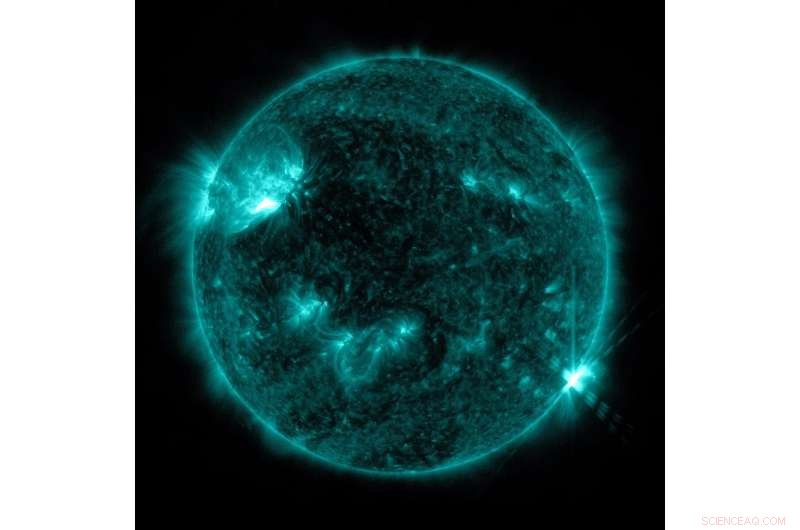
NASA's Solar Dynamics Observatory captured this image of a solar flare – as seen in the bright flash in the lower right portion of the image– at 9:35 p.m. EST on April 19, 2022. The image shows a subset of extreme ultraviolet light that highlights the extremely hot material in flares and is colorized in SDO channel color blue. Credit: NASA/SDO
The Sun emitted two solar flares on April 19, 2022, one moderate peaking at 9:35 p.m. EST and one strong peaking at 11:57 p.m. EST. NASA's Solar Dynamics Observatory, which watches the Sun constantly, captured an image of both events.
Solar flares are powerful bursts of energy. Flares and solar eruptions can impact radio communications, electric power grids, navigation signals, and pose risks to spacecraft and astronauts.
The flare pictured above is classified as an M-Class flare. M-class flares are a class below the most intense flares, the X-class flares. The number provides more information about its strength.
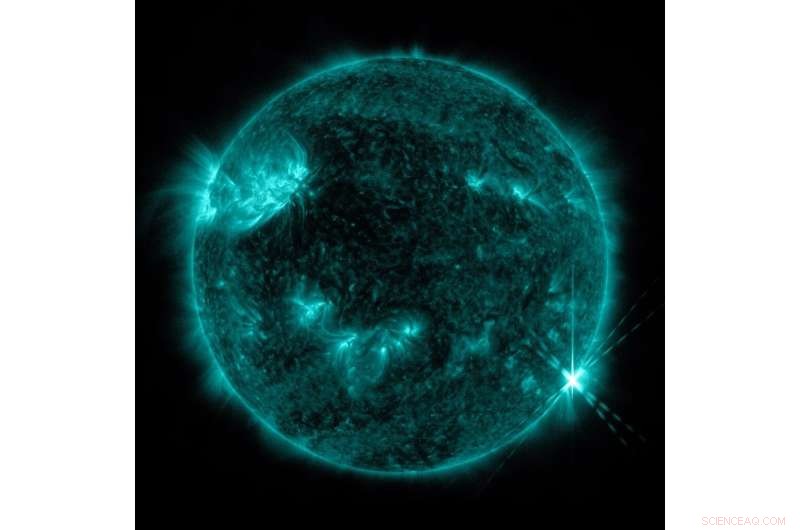
NASA’s Solar Dynamics Observatory captured this image of a solar flare – as seen in the bright flash in the lower right portion of the image– at 11:57 p.m. EST on April 19, 2022. The image shows a subset of extreme ultraviolet light that highlights the extremely hot material in flares and is colorized in SDO channel color blue. Credit: NASA/SDO
The flare pictured above is classified as an X-Class flare. X-class denotes the most intense flares.
To see how such space weather may affect Earth, please visit NOAA's Space Weather Prediction Center https://spaceweather.gov/.