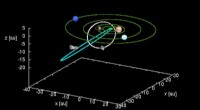
* Kepler's Laws of Planetary Motion: Johannes Kepler, a brilliant astronomer, figured out the laws that govern planetary motion. His second law states that planets sweep out equal areas in equal times. This means that a planet moves faster when it's closer to the Sun and slower when it's farther away.
* Gravity and Orbital Velocity: The force of gravity between the Sun and a planet determines the planet's orbital speed. The closer a planet is to the Sun, the stronger the gravitational pull, and the faster it needs to move to stay in orbit.
* Orbital Period: The time it takes a planet to complete one orbit around the Sun is called its orbital period. The farther a planet is from the Sun, the longer its orbital period.
Example:
* Mercury, being the closest planet to the Sun, orbits at a much faster speed than Neptune, which is the farthest planet. Mercury takes only 88 Earth days to complete one orbit, while Neptune takes 165 Earth years.
So, in short, planets orbit at different speeds due to their varying distances from the Sun and the corresponding gravitational forces.