1. Observations of Planetary Motion:
* Retrograde Motion: Planets appeared to move backwards in their orbits at certain points. This was difficult to explain with the Earth-centered (geocentric) model, which required complex and increasingly convoluted explanations.
* Phases of Venus: Galileo's observations of Venus's phases, similar to the Moon's, strongly suggested it was orbiting the Sun, not the Earth.
2. Ancient Greek Philosophers:
* Aristarchus of Samos: He proposed a heliocentric model around 250 BC, arguing that the Earth revolved around the Sun, but lacked the observational evidence to convince his contemporaries.
* Heraclides Ponticus: He suggested that Mercury and Venus orbited the Sun, while the Sun continued to orbit the Earth. This provided a more elegant explanation for their peculiar movements.
3. Mathematical and Observational Improvements:
* Nicolaus Copernicus: He was a skilled mathematician and astronomer who built upon the work of his predecessors. His model was mathematically simpler and explained retrograde motion more elegantly.
* Tycho Brahe: A brilliant observer, he meticulously documented the positions of planets for decades, providing the data that helped Kepler refine the heliocentric model.
* Johannes Kepler: He formulated his three laws of planetary motion, demonstrating that planets moved in ellipses around the Sun, further solidifying the heliocentric model.
4. Challenges to the Geocentric Model:
* Lack of Stellar Parallax: The absence of observable shifts in the apparent positions of stars as the Earth moved around the Sun, predicted by the heliocentric model, was a major challenge for its acceptance. This was later explained by the vast distances to stars.
* Religious Opposition: The geocentric model aligned well with the prevailing religious views of the time, placing Earth at the center of the universe. The heliocentric model was seen as challenging the established order and was met with resistance from some religious authorities.
5. The Scientific Revolution:
* The Renaissance: This period of intellectual revival encouraged a more critical and observational approach to science.
* New Technology: The invention of the telescope allowed for more precise observations of the heavens, providing further evidence to support the heliocentric model.
In Summary:
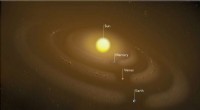
The heliocentric model arose from a combination of careful observation, mathematical reasoning, philosophical inquiry, and a shift in the scientific paradigm. It took centuries of research and debate to displace the long-held geocentric model and establish the Sun as the center of our solar system.