Understanding the motion and distance of galaxies is a cornerstone of modern cosmology. Here's a breakdown of the key factors involved:
Galaxy Motion:
* Hubble's Law: This fundamental law states that galaxies are moving away from us at a speed proportional to their distance. The further away a galaxy is, the faster it's receding. This expansion of the Universe is driven by a mysterious force called dark energy.
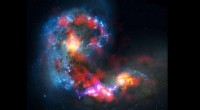
* Gravitational Interactions: Galaxies are not isolated objects; they interact gravitationally with each other and with clusters of galaxies. These interactions can cause galaxies to move towards or away from each other, influencing their overall motion.
* Peculiar Velocity: Galaxies don't simply move according to Hubble's Law. They also have their own "peculiar velocities" due to local gravitational influences. These can be relatively small compared to the Hubble flow, but they add complexity to understanding galactic motion.
Galaxy Distance:
* Standard Candles: These are celestial objects with known intrinsic brightness. By comparing their apparent brightness to their intrinsic brightness, astronomers can determine their distance. Examples include Type Ia supernovae and Cepheid variable stars.
* Redshift: The light from distant galaxies is stretched, causing its wavelengths to shift towards the red end of the spectrum. This "redshift" is directly proportional to the distance of the galaxy, as predicted by Hubble's Law.
* Parallax: This method measures the apparent shift in a star's position as Earth orbits the Sun. Though primarily used for nearby stars, it can be used for nearby galaxies by measuring the apparent movement of stars within them.
* Cosmic Distance Ladder: This framework uses various distance measurement techniques in a hierarchical manner. Techniques like parallax are used for nearby objects, then their distance is used to calibrate other methods for more distant objects, and so on.
Challenges and Future Research:
* Dark Matter: This invisible form of matter exerts a significant gravitational influence, affecting galaxy motion. Understanding the distribution and behavior of dark matter is crucial for accurate measurements.
* Improving Distance Measurement Techniques: Astronomers continuously strive for more precise distance measurement techniques to probe the universe's vastness and understand its history.
* Expanding Our Understanding: The study of galaxy motion and distance remains an ongoing quest to unravel the mysteries of the Universe and our place within it.
In conclusion, determining galaxy motion and distance involves a multifaceted approach that combines theoretical models, observational data, and intricate calculations. It's a complex but rewarding endeavor that continuously pushes the boundaries of our understanding of the cosmos.