Here's a breakdown of how astronomers use different types of electromagnetic radiation:
Visible Light:
* What it tells us: We see this light with our eyes! It reveals the color, shape, and surface features of objects.
* Examples: We can see the colors of stars, the swirling patterns of gas clouds, and the surface of planets.
Infrared Radiation:
* What it tells us: Infrared light reveals heat signatures. It can penetrate dust clouds, allowing astronomers to see objects obscured from visible light.
* Examples: Infrared telescopes can observe the formation of stars hidden within dust clouds, and they can map the distribution of heat on planets.
Ultraviolet Radiation:
* What it tells us: Ultraviolet light reveals hot, energetic phenomena. It can be used to study the atmospheres of planets and stars, and to detect the presence of hot gas and dust.
* Examples: Ultraviolet observations can help us understand the evolution of stars and the formation of galaxies.
X-rays and Gamma Rays:
* What it tells us: These high-energy rays are emitted by extremely hot and energetic events. They reveal the presence of black holes, exploding stars (supernovae), and the violent processes that occur in the universe.
* Examples: X-ray telescopes help us study the accretion disks around black holes, while gamma-ray observatories help us understand the origin of cosmic rays.
Radio Waves:
* What it tells us: Radio waves can reveal the presence of cold gas, magnetic fields, and the structure of distant galaxies.
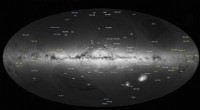
* Examples: Radio telescopes are used to study the structure of our galaxy, the Milky Way, and to map the distribution of matter in the universe.
The Power of the Electromagnetic Spectrum
By studying the entire spectrum of electromagnetic radiation, astronomers can gather a comprehensive understanding of the universe:
* Composition: By analyzing the wavelengths of light emitted by objects, astronomers can determine the elements and molecules that make them up.
* Temperature: The intensity of light in different wavelengths gives clues about the temperature of the object.
* Motion: The Doppler effect tells astronomers if an object is moving towards or away from us, and how fast it is moving.
* Evolution: By observing objects at different wavelengths, we can piece together their life cycles and evolution.
Conclusion:
Electromagnetic radiation is the key to unlocking the secrets of the universe. By studying light from all parts of the spectrum, astronomers can piece together a detailed picture of the cosmos, from the birth of stars to the evolution of galaxies.