Here's a breakdown:
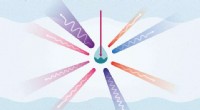
* Visible light: This is the light we can see with our eyes, making up the rainbow of colors. Hubble's cameras capture this light, allowing us to see stunning images of galaxies, nebulae, and planets.
* Ultraviolet light: This type of light has shorter wavelengths than visible light, making it invisible to the human eye. Hubble's ultraviolet capabilities allow astronomers to study hot, young stars, the composition of distant atmospheres, and the early universe.
* Near-infrared light: This light has longer wavelengths than visible light and can penetrate dust clouds. It allows astronomers to see through these clouds and study objects that would otherwise be hidden, such as the birth of stars and the formation of planets.
While Hubble can't see all forms of light, like radio waves or X-rays, its capabilities in these three ranges have revolutionized our understanding of the universe.