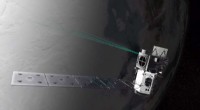
* Gravity's Pull: Earth's gravity pulls on everything around it, including satellites. This pull is what keeps them in orbit.
* Forward Motion: Satellites are launched with a tremendous amount of forward velocity. This velocity is crucial because it allows them to constantly "miss" the Earth as they fall.
Imagine this:
* You throw a ball horizontally. It falls to the ground because of gravity.
* Now imagine throwing the ball harder. It travels further before hitting the ground.
* If you could throw the ball fast enough, it would travel so far that the curvature of the Earth would cause the ground to "curve away" beneath it.
This is essentially what a satellite does:
* Its forward speed is so great that it continuously falls towards the Earth, but the Earth's curvature curves away at the same rate, causing it to orbit.
Think of it like a balancing act:
* Gravity is pulling the satellite down.
* The satellite's forward velocity is pushing it outwards.
These two forces are constantly in balance, resulting in a stable orbit.
Important Note: If a satellite loses speed, it will start to fall closer to Earth. If it loses too much speed, it will eventually fall out of orbit and crash into the Earth.