1. Temperature and Color:
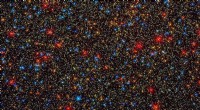
* Hotter stars are bluer. This is because hotter stars emit more radiation at shorter wavelengths, which fall within the blue part of the visible spectrum.
* Cooler stars are redder. Cooler stars emit more radiation at longer wavelengths, falling within the red part of the visible spectrum.
2. Temperature and Energy Output:
* Higher temperature means higher energy output. A star's temperature is a direct measure of the average kinetic energy of its particles. The hotter the star, the faster these particles move, and the more energy they radiate.
3. Temperature, Luminosity, and Size:
* Luminosity is directly related to temperature and size. The Stefan-Boltzmann law states that the total energy radiated per unit area of a blackbody is proportional to the fourth power of its absolute temperature. This means that a star's luminosity increases dramatically with increasing temperature. Additionally, a larger star has a greater surface area, radiating more energy overall.
4. The Hertzsprung-Russell Diagram:
* The relationship between temperature and luminosity is visually represented in the Hertzsprung-Russell (H-R) diagram. This diagram plots stars according to their luminosity (on the vertical axis) and spectral type (a proxy for temperature) on the horizontal axis.
* The H-R diagram shows a clear trend: hotter stars are generally more luminous. This is represented by the "main sequence," a diagonal band on the diagram where most stars reside.
5. Exceptions:
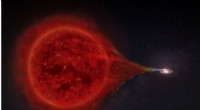
* Giant and Supergiant stars: While these stars are significantly larger than main sequence stars, they are cooler, but still have very high luminosity due to their immense size.
In summary:
* A star's temperature is a key factor determining its luminosity.
* Hotter stars are generally more luminous than cooler stars.
* The relationship between temperature and luminosity is not strictly linear, but rather follows a complex pattern.
* The H-R diagram provides a visual representation of this relationship and allows astronomers to classify stars based on their temperature and luminosity.
Remember that this is a simplified explanation. Stellar evolution, composition, and other factors can also influence a star's temperature and luminosity.