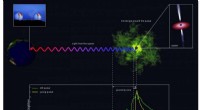
Here's how it works:
1. Observation: Astronomers observe a star from two different points in Earth's orbit around the Sun, typically six months apart. This creates a baseline, the distance between the two observation points, which is roughly the diameter of Earth's orbit.
2. Angle Measurement: The star's apparent position against the background of distant stars appears to shift slightly due to the change in the observer's position. Astronomers measure this small angular shift, called the parallax angle.
3. Distance Calculation: The distance to the star can be calculated using the parallax angle and the baseline distance. The smaller the parallax angle, the farther away the star is.
Formula:
Distance (in parsecs) = 1 / parallax angle (in arcseconds)
Key Points:
* Parallax is only measurable for relatively nearby stars.
* The larger the parallax angle, the closer the star.
* One parsec (pc) is equal to 3.26 light-years.
Parallax is a fundamental technique in astronomy for measuring stellar distances and understanding the scale of the universe.