1. Gravity: The Sun's immense gravity pulls on the Earth, keeping it in orbit. The Earth is constantly falling towards the Sun, but its sideways motion (its orbital velocity) prevents it from actually hitting the Sun.
2. Initial Angular Momentum: During the formation of the solar system, a cloud of gas and dust collapsed under its own gravity. As this cloud collapsed, it began to spin faster. This spinning motion, known as angular momentum, was conserved and transferred to the planets as they formed. The Earth inherited this initial angular momentum from the collapsing cloud, which is why it has a natural tendency to move in a curved path around the Sun.
3. Centrifugal Force: The Earth's orbital velocity creates a centrifugal force that acts outward, counteracting the Sun's gravitational pull. This balance between gravity and centrifugal force is what keeps the Earth in a stable orbit.
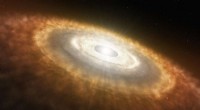
4. Accretion Disk: The solar system formed from a spinning disk of gas and dust called an accretion disk. As the Sun formed at the center of this disk, the remaining material clumped together, eventually forming the planets. The planets inherited the angular momentum of the original disk, causing them to orbit in the same plane and direction.
In summary, the Earth rotates around the Sun because of the initial conditions of the solar system, the gravitational force of the Sun, and the balance between this force and the centrifugal force created by the Earth's orbital velocity.