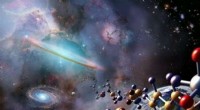
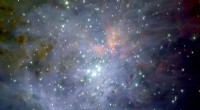
1. Nebulae: The process begins with giant clouds of gas and dust called nebulae. These nebulae are mostly composed of hydrogen and helium, with smaller amounts of heavier elements.
2. Gravity and Collapse: Over time, gravity pulls the particles in the nebula closer together. As the cloud collapses, it spins faster and faster, like a figure skater pulling in their arms.
3. Protoplanetary Disk: The collapsing nebula flattens into a spinning disk called a protoplanetary disk. This disk is still very hot and contains a lot of dust and gas.
4. Accretion: Within the protoplanetary disk, small particles of dust and ice start to stick together due to electrostatic forces and collisions. These tiny particles grow larger over time through a process called accretion.
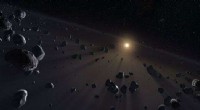
5. Planetesimals: As these particles continue to collide and accrete, they form larger objects called planetesimals. These are the building blocks of planets.
6. Planetary Formation: Planetesimals continue to collide and grow until they become large enough to have their own gravitational pull. These massive objects sweep up the remaining dust and gas in the protoplanetary disk, eventually forming planets.
So, dust clouds don't "form" planets, they are the ingredients that are pulled together by gravity to form planets. The process of accretion and gravitational pull is responsible for the formation of planets from dust clouds.