Physical Characteristics:
* Size and Mass: Jupiter is a gas giant, significantly larger and more massive than Venus. It's the largest planet in our solar system, with a diameter 11 times larger than Venus and a mass 318 times greater.
* Density: Jupiter's density is much lower than Venus due to its gaseous nature. Venus, being a rocky planet, is denser.
* Composition: Venus is a terrestrial planet with a solid surface composed mainly of rock. Jupiter is a gas giant, primarily composed of hydrogen and helium. It has a rocky core, but it's much smaller than the planet itself.
* Rotation: Venus rotates incredibly slowly, taking longer than its orbital period. This means a day on Venus is longer than its year. Jupiter, on the other hand, rotates very rapidly, completing a rotation in under 10 hours.
* Magnetic Field: Jupiter has a strong magnetic field, much stronger than Earth's. This is due to the planet's rapid rotation and its internal metallic hydrogen. Venus, on the other hand, has a very weak magnetic field, possibly because of its slow rotation.
Atmospheric Composition:
* Density and Pressure: Venus has a thick, dense atmosphere that exerts an immense pressure at its surface, about 92 times Earth's atmospheric pressure. Jupiter's atmosphere is less dense but much deeper, extending thousands of kilometers.
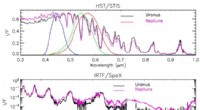
* Composition: Venus's atmosphere is mainly composed of carbon dioxide (96.5%), with nitrogen (3.5%) as a minor component. This dense CO2 atmosphere creates a powerful greenhouse effect, leading to extreme surface temperatures. Jupiter's atmosphere is primarily composed of hydrogen (89.8%) and helium (9.9%), with traces of methane, ammonia, and water vapor.
* Clouds: Venus's atmosphere is veiled in thick clouds of sulfuric acid, reflecting sunlight and giving it its high albedo. Jupiter's colorful bands are due to different cloud layers, composed of ammonia, ammonium hydrosulfide, and water ice.
* Weather Patterns: Venus has an incredibly slow and stable atmosphere, with little to no wind. Jupiter, on the other hand, experiences intense storms and powerful jet streams due to its rapid rotation and internal heat. Its iconic Great Red Spot is a massive storm that has been raging for centuries.
In summary, Venus and Jupiter are vastly different planets:
* Venus is a hot, dense, rocky planet with a thick, poisonous atmosphere, while Jupiter is a massive gas giant with a dynamic atmosphere and a powerful magnetic field.
* Their atmospheric compositions and weather patterns are dramatically different, reflecting their contrasting physical characteristics.