1. Rotation:
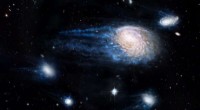
- The Milky Way is a spiral galaxy, meaning it spins around its center like a giant, flat disc.
- The Sun, along with our solar system, orbits the galactic center once every 225 to 250 million years.
- This rotation speed is about 515,000 miles per hour (828,000 kilometers per hour).
2. Motion within the Local Group:
- The Milky Way is part of a small group of galaxies called the Local Group, which also includes Andromeda and Triangulum.
- These galaxies are gravitationally bound and move together through space.
- The Local Group is moving towards a larger cluster of galaxies called the Virgo Cluster.
3. Motion within the Universe:
- The Universe is expanding, meaning that all galaxies are moving away from each other.
- This expansion is due to the Big Bang, and it causes the Milky Way to move away from most other galaxies.
4. Peculiar Motion:
- In addition to these larger-scale motions, galaxies also have their own "peculiar motion" due to gravitational interactions with nearby galaxies.
- This can be seen as deviations from the overall Hubble flow (the expansion of the universe).
In summary: The Milky Way's motion through space is a complex combination of rotation, motion within its local group, expansion of the universe, and peculiar motion. This makes it difficult to pinpoint a single direction or speed for the Milky Way's motion. However, we can say that it's moving through space at a very high velocity, likely due to a combination of these factors.