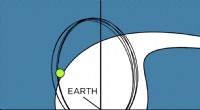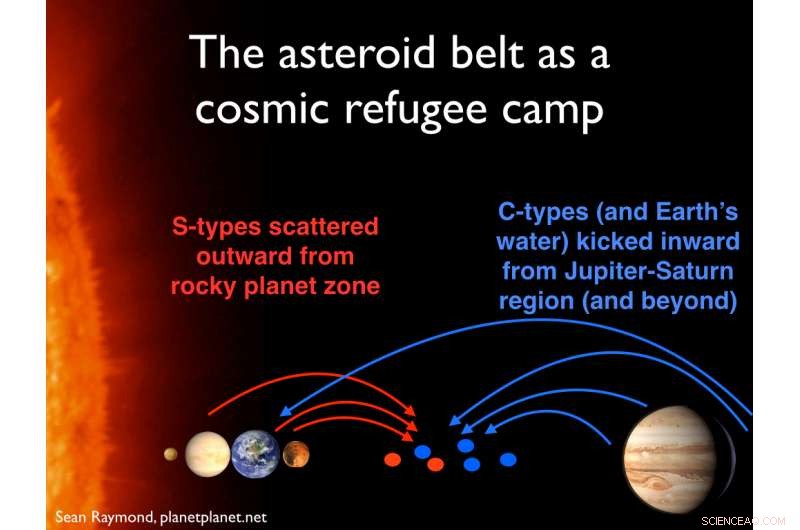
The asteroid belt may be have started out empty and was populated by objects from across the Solar System. Credit: Sean Raymond, planetplanet.net
(Phys.org)—A pair of researchers with Université de Bordeaux has proposed a new theory to explain the origin of the asteroid belt. In their paper published in Science Advances, Sean Raymond and Andre Izidoro describe their theory and what they found when trying to model it.
The asteroid belt (sometimes referred to as the main asteroid belt) orbits between Mars and Jupiter. It consists of asteroids and minor planets forming a disk around the sun. It also serves as a sort of dividing line between the inner rocky planets and outer gas giants. Current theory suggests that the asteroid belt was once much more heavily populated, but the gravitational pull of Jupiter flung approximately 99 percent of its former material to other parts of the solar system or beyond. Astronomers also assumed that Jupiter's gravity prevented the material in the belt from coalescing into larger planets. In this new effort, the researchers propose a completely different explanation of the asteroid belt's origin—suggesting that the belt started out as an empty space and was subsequently filled by material flung from the inner and outer planets.
The researchers note that asteroids closer to the rocky planets (called S-type asteroids) tend to contain silicate, similar to the inner planets. By contrast, asteroids in the belt closer to the gas giants (called C-type asteroids) tend to contain more carbon, making them more like the gas giants. This, the researchers note, suggests that the asteroids actually came from the planets as they were forming—excess material was essentially kicked away into the asteroid belt, where it remains today.
To test their theory, the researchers created a model mimicking the early solar system, during which the asteroid belt starts out as empty. Running the model forward, they report, showed that it was possible that material from the other planets could have made its way to the belt, resulting in the disk observed today. They plan to continue their research to see if they can find more evidence for their theory, or for the conventional view.
© 2017 Phys.org