1. The Rocket Equation:
* Thrust: Rockets generate thrust by burning fuel and expelling hot gas out of their nozzles. This creates a force that pushes the rocket upwards.
* Newton's Third Law: For every action, there is an equal and opposite reaction. The rocket's exhaust pushes downwards, propelling the rocket upwards.
* Momentum: To reach space, rockets need to achieve a specific velocity known as escape velocity, which is approximately 11.2 km/s (25,000 mph) for Earth.
2. Stages:
* Multi-Stage Rockets: Most rockets are multi-stage, meaning they have multiple sections that detach and discard fuel tanks as they ascend.
* Each stage has its own engine and fuel supply.
* After one stage burns out, it separates and the next stage ignites. This helps reduce the overall weight of the rocket and improves efficiency.
3. The Launch Process:
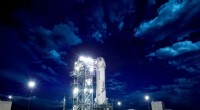
* Liftoff: The rocket ignites its engines and begins to ascend vertically.
* Gravity Turn: Once the rocket gains enough speed, it begins to tilt over in a "gravity turn." This maneuver helps conserve fuel and maximize efficiency.
* Staging: As the rocket climbs higher, stages separate and are discarded.
* Orbit: After reaching the desired altitude, the final stage ignites to propel the spacecraft into orbit around Earth.
4. Other Launch Vehicles:
* Spaceplanes: Reusable vehicles like the Space Shuttle were a hybrid of spacecraft and airplanes. They used a combination of rockets and wings to reach space.
* Sounding Rockets: Smaller rockets designed for shorter flights, usually used for atmospheric research.
Key Concepts:
* Escape Velocity: The minimum speed a spacecraft needs to escape Earth's gravitational pull and enter space.
* Orbital Velocity: The speed a spacecraft needs to maintain a stable orbit around Earth.
* Payload: The spacecraft, satellite, or cargo being carried into space.
In Summary:
Spacecraft get into space by using powerful rockets that generate thrust by burning fuel and expelling hot gas. These rockets are typically multi-stage, allowing for efficient ascent. They achieve escape velocity to break free of Earth's gravitational pull and enter orbit.