Here's what happens:
After Helium:
* Triple Alpha Process: The star's core heats up even further, allowing helium nuclei to fuse together in a process called the "triple alpha process". This process creates carbon.
* Carbon Burning: If the star is massive enough (at least 8 times the mass of our sun), the core will continue to heat up and the carbon will begin to fuse with helium and other carbon nuclei, forming oxygen, neon, sodium, and magnesium.
* Neon Burning: Further heating leads to the fusion of neon into oxygen and magnesium.
* Oxygen Burning: Finally, oxygen will fuse to produce silicon and sulfur.
Beyond Oxygen:
* Silicon Burning: The star's core becomes incredibly dense and hot, allowing for the fusion of silicon into iron. Iron is the most stable element and cannot be fused into anything heavier.
* Iron Catastrophe: Iron fusion does not produce energy but actually consumes it. This leads to a rapid collapse of the star's core, resulting in a supernova explosion.
The Aftermath:
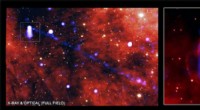
* Supernova Remnant: The explosion throws the star's outer layers into space, creating a nebula.
* Neutron Star or Black Hole: The core of the star collapses further, forming either a neutron star (for smaller stars) or a black hole (for the most massive stars).
It's important to remember that not all stars go through all of these stages. The process depends on the initial mass of the star. Smaller stars like our sun will eventually become white dwarfs, while larger stars will eventually end their lives in spectacular supernova explosions.