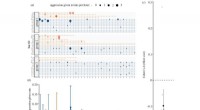
Multiwavelength light curves of PG 1553+113 covering gamma-ray, X-ray, UV, optical and radio bands with epochs from 2012 to 2020. The gamma-ray light curve is shown with a 20 day binning and the data of X-ray and optical/UV are rebinned to one data point for each observation. Credit: Huang et al., 2021.
Using space observatories and ground-based facilities, Chinese astronomers have investigated a blazar known as PG 1553+113. Results of this study shed more light on the behavior of this object, indicating that it hosts a supermassive black hole binary system. The research was published October 5 on arXiv.org.
Blazars are very compact quasars associated with supermassive black holes (SMBHs) at the centers of active, giant elliptical galaxies. They belong to a larger group of active galaxies that host active galactic nuclei (AGN), and are the most numerous extragalactic gamma-ray sources. Their characteristic features are relativistic jets pointed almost exactly toward the Earth.
At a redshift of 0.5, PG 1553+113 is a blazar showcasing a 2.2-year quasi-periodicity in its gamma-ray light curve. Previous studies of this blazar have suggested that this variability may be related to a jet precession in a SMBH binary system. However, the gamma-ray light curve shows weaker flares near the main ones that might indicate the signs of the twin jets in the system.
Therefore, a team of astronomers led by Shifeng Huang of Shandong University in China decided to investigate the X-ray light curve and spectra of PG 1553+113 observed between 2012 and 2020. They analyzed the data obtained with NASA's Swift and Fermi spacecraft, ESA's XMM-Newton satellite, as well as the Owens Valley Radio Observatory (OVRO).
"We study the flux and spectral variability of PG 1553+113 on long-term timescales using Swift and XMM-Newton X-ray data collected for the period 2012–2020," the researchers wrote in the paper.
The X-ray light curve of PG 1553+113 exhibits several main and weak flares during the eight-year-long monitoring campaign. It was noted that generally, the main X-ray flares and some weak flares are consistent with the corresponding flares observed on the gamma-ray band. The astronomers observed a "harder-when-brighter" behavior in the X-ray for both main and weak flares, and a "softer-when-brighter" behavior in quiescent states.
According to the paper, the variability in the X-ray band is most likely due to a precession effect of two jets in a supermassive black hole binary system. The astronomers explained that each black hole carries its own jet and the movement of the black holes on the orbit causes the quasi-periodic variation on the light curves.
Based on the results for the X-ray light curve and the correlation between the disk and the jet, the researchers calculated the mass of this SMBH binary system. They found that the primary black hole has a mass of about 347 million solar masses, while the mass of the secondary one is approximately 140 million solar masses, what gives a mass ratio at a level of 0.41.
The authors of the paper added that their results are uncertain and more high cadence observations of PG 1553+113 are required to draw final conclusions regarding the SMBH binary.
© 2021 Science X Network